


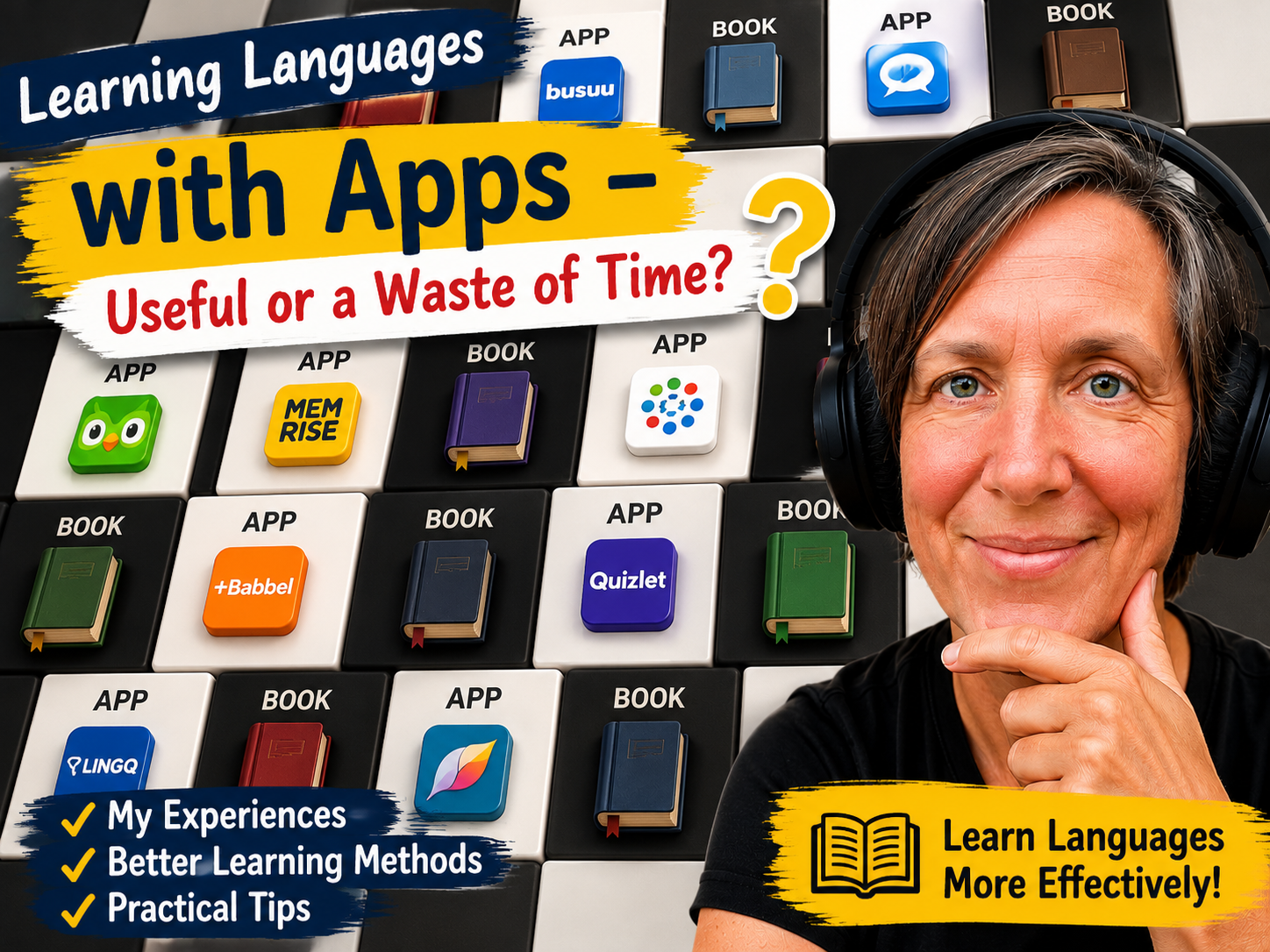
Language-learning apps are everywhere these days. Many of them promise that you can make rapid progress by spending just a few minutes a day. But how effective are these apps really? I recently tested a Russian learning app to see how it works. In this article, I’ll show you step by step how the app is structured and explain why I personally prefer a different approach to learning languages.
How the App Works
As an example, I installed a Russian learning app.
After launching it, you go through a few basic steps:
- Select your native language: German
- Select your target language: Russian
- Click “Start”
- Choose “Continue Learning”
- Set a goal, for example “Learn one word per day”
- Allow or skip notifications
After that, you are taken directly to your first lesson.
In my example, the app selected the category People and the subcategory Family.
Among the first vocabulary items were:
- sister
- parents
- father
- man
- children
- mother
After only a few words, the app already displayed an offer for the premium version, which I skipped.
I expected to continue with the lesson, but instead the app started all over again. Small issues like this interrupt the learning process and waste valuable time.
The Disadvantages of Language-Learning Apps
This is one of the things that bothers me about many language-learning apps.
Before you can even start learning, you first have to learn how to use the app itself. You need to understand its layout, discover which features are free, and figure out when advertisements or purchase offers suddenly appear.
On top of that, most of us already spend far too much time looking at our smartphones. If I’m going to use my phone for learning, I want that time to be as productive as possible.
That’s why I prefer reading a story, listening to a text, or translating a passage from my novel. Afterwards, I discuss it with my language partner. This helps me learn far more effectively than simply repeating isolated vocabulary words.
After all, what do I gain from memorizing twenty new words?
Maybe I now know how to say “sister,” “mother,” or “parents” in Russian. But I still can’t build a single correct sentence.
Most apps only show words in the nominative case, and that’s exactly where the real problem begins.
Suppose I want to say:
“The house of my parents.”
In Russian, the word “parents” suddenly changes into the genitive case.
At that point, knowing only the basic vocabulary word is no longer enough.
I also need to know:
- which grammatical case to use,
- how the word ending changes,
- the grammatical gender of the noun,
- which adjective ending is required,
- and the special grammar rules of the language.
For example, Russian usually omits the verb “to be” in the present tense.
If I want to say:
“My parents’ house is beautiful.”
I have to apply all of these grammar rules at the same time.
A simple vocabulary list cannot teach that.
That’s why I see apps only as a supplement. They can be useful for reviewing individual words, but in my opinion they are not sufficient for truly learning a language.
How I Learn More Effectively Than with Apps
I prefer learning new words immediately in complete sentences.
Take the following example:
Я люблю мою машину.
“I love my car.”
Immediately, I can see several grammatical forms at the same time.
The word машину is no longer in its dictionary form машина, but already appears in another grammatical case.
The possessive pronoun мою has also changed accordingly.
I can then check that the base word машина ends in -а and is a feminine noun.
Now I can immediately build another sentence, for example:
Моя машина красивая.
“My car is beautiful.”
This way I learn vocabulary, grammar, sentence structure, and word endings all at once. I remember them much better than isolated vocabulary words.
Declension Tables Are Often More Helpful
I find declension tables even more useful.
They present every grammatical form of a word in a clear overview.
For the Russian word родители (“parents”), for example, you can find sentences such as:
- Do you write to your parents often?
- Tom’s parents were both teachers.
- You should help your parents.
- My parents were proud of me.
This immediately shows how the word changes in different grammatical cases.
If a form is missing—for example the genitive—you can simply look it up.
For the sentence
“My parents’ house.”
the genitive form is:
Дом родителей.
That’s exactly why I prefer declension tables over simple vocabulary lists.
Instead of memorizing only the basic form, I learn every important form of the word.
Many declension tables also indicate the correct stress, which is especially helpful in Russian.
Which Apps Do You Use?
Now I’d like to hear from you.
Do you use language-learning apps?
If so, which ones would you recommend?
Feel free to leave a comment below and tell me which languages you’re currently learning.
365 Steps – Online Magazine, August 2026 Edition
In the August 2026 edition of my 365 Steps Online Magazine, you’ll find a practical checklist of all the features a good language-learning app should have.
It will help you evaluate new apps much more quickly and avoid wasting time on programs that won’t really improve your language skills.
I also explain why each feature matters and what I personally look for when choosing a language-learning app.
Learn Languages with My Bilingual Course
Alongside my videos, I’m currently developing my 169-section bilingual language course “Relaxed to A1” for beginners and intermediate learners.
What makes this course special is that you never learn vocabulary in isolation. Instead, every new word appears naturally within a complete story.
By combining videos, audio recordings, texts, a novel, vocabulary lists, exercises, and additional mini-books, you learn vocabulary, grammar, pronunciation, and sentence structure simultaneously.
This creates a natural language-learning process step by step—without relying on endless vocabulary lists.
You can find an overview of my bilingual course “Relaxed to A1” here:
- Dreamy Tiny House Diary – May 2026

- The Bible – An Illustrated Story in 6 Languages – Genesis 17

- Protected: Questions about “002 To Be or Not to Be” – Practise the Verb “to Be” in All Tenses

- To be or not to be – that is the question (comic in six languages for learning goal 2)

- How a German Lesson with Me Works – Structure, Process, and Organization of My German Lessons

Leave a Reply