


Latin often seems more complicated at first than it actually is. One reason for this is that word order in Latin is more flexible than in English. Therefore, we cannot simply assume that the first word is the subject and the next word is the object.
Instead, we look at the forms of the words. The endings are particularly important.
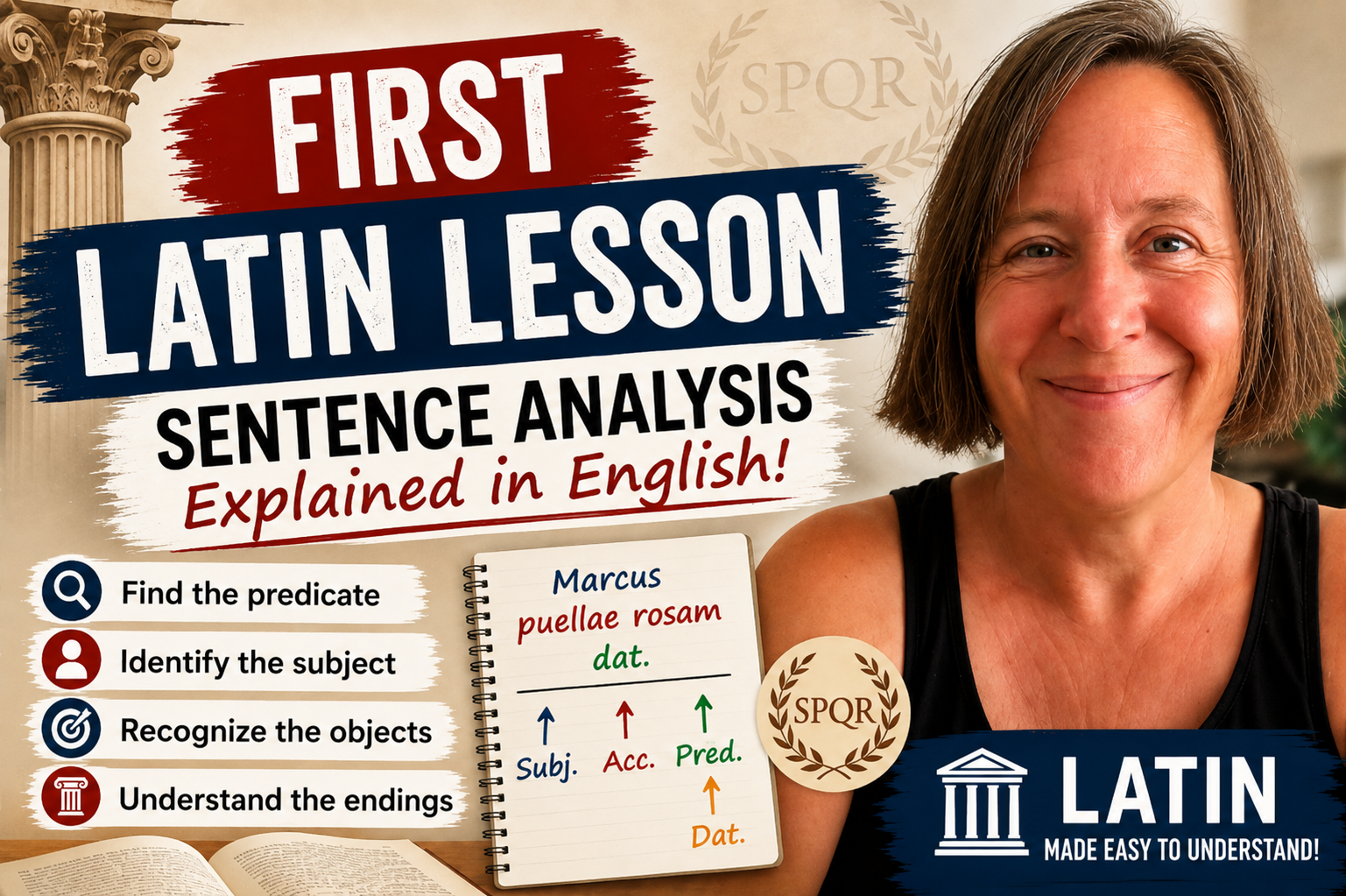
In this first Latin lesson, we will learn how to analyse a simple Latin sentence systematically.
1. First, we look for the predicate
Let us start with a simple sentence:
Marcus amicum videt.
Marcus sees the friend.
The predicate is:
videt = he/she/it sees
The infinitive of the verb is:
vidēre = to see
We remove the infinitive ending -re:
vidēre → vidē-
What remains is the present stem.
Now we add the personal ending -t:
vidē- + t → videt
The ending -t tells us:
3rd person singular, present tense, active voice, indicative mood
So we know: someone sees.
Now we need to find out who sees.
2. The subject is in the nominative
Marcus amicum videt.
We ask:
Who or what sees?
Marcus.
Marcus is the subject and is in the nominative singular.
Marcus belongs to the o-declension and is masculine. The ending -us can indicate the nominative singular of a masculine noun of the o-declension.
Marcus = nominative singular
So far, we have:
Marcus sees …
Now we still need the object.
3. The accusative object
We ask:
Whom or what does Marcus see?
amicum = the/a friend
amicum is in the accusative singular. Here, we can recognise this by the ending -um.
amicus → nominative singular
amicum → accusative singular
The whole sentence has now been analysed:
Marcus = subject
amicum = accusative object
videt = predicate
Marcus amicum videt.
Marcus sees the/a friend.
Latin has neither definite nor indefinite articles. Therefore, depending on the context, amicum can mean either “the friend” or “a friend”.
4. Why endings are so important
Let us look at a similar sentence:
Amicus Marcum videt.
Now the sentence means:
The friend sees Marcus.
Why?
amicus ends in -us and is in the nominative singular here.
Marcum ends in -um and is in the accusative singular.
videt once again means “he/she/it sees”.
So we can recognise from the forms:
amicus = subject
Marcum = accusative object
videt = predicate
The endings help us recognise the function a word has in the sentence.
5. The a-declension
Now we add a second declension:
Puella Marcum amat.
The girl loves Marcus.
puella belongs to the a-declension.
puella = nominative singular, feminine
It is the subject.
amat is the predicate.
The infinitive is:
amare = to love
We remove -re:
amare → ama-
ama- is the present stem.
Now we add the personal ending -t for the 3rd person singular:
ama- + t → amat
amat = he/she/it loves
Marcum is again in the accusative singular and is the accusative object.
We ask:
Whom or what does the girl love?
Marcus.
6. Singular and plural
Now let us change the sentence:
Puellae Marcum amant.
The girls love Marcus.
What has changed?
puella → the girl
puellae → the girls
puellae is in the nominative plural here.
The verb changes too:
amat → he/she/it loves
amant → they love
The ending -nt indicates the 3rd person plural here.
amare → ama- → ama- + nt → amant
Subject and predicate agree in number:
puella amat = the girl loves
puellae amant = the girls love
This is a very important clue when analysing a sentence.
7. A verb with two objects
Now let us expand the sentence:
Marcus puellae rosam dat.
Marcus gives the girl a/the rose.
The verb dat comes from:
dare = to give
dare → da- + t → dat
dat = he/she/it gives
Now we ask our questions systematically again.
Who or what gives?
Marcus.
Marcus is the subject and is in the nominative singular.
To whom does Marcus give something?
puellae = to the girl
puellae is in the dative singular here.
The dative answers, among other things, the question:
To whom?
What does Marcus give the girl?
rosam = a/the rose
rosam is in the accusative singular. The ending -am indicates the accusative singular in the a-declension.
So we have:
Marcus = subject, nominative singular
puellae = dative object, dative singular
rosam = accusative object, accusative singular
dat = predicate, 3rd person singular, present active indicative
8. One ending can have several meanings
Now we come across an important feature of Latin.
The form puellae can have several grammatical functions.
puellae can be:
genitive singular = of the girl
dative singular = to/for the girl
nominative plural = the girls
This is nothing unusual. In English, too, identical forms can have different grammatical functions.
Think, for example, of you:
You are here.
This can refer to one person or several people. Only the context tells us exactly what is meant.
It is similar in Latin.
9. How do we find out what puellae means?
Let us compare two sentences:
Puellae rosam amant.
Marcus puellae rosam dat.
In the first sentence, we start with the predicate:
amant
The ending -nt tells us that it is the 3rd person plural.
So we need a plural subject.
rosam cannot be the subject. The ending -am clearly indicates the accusative singular here.
puellae, on the other hand, can be nominative plural.
Therefore:
puellae = the girls
Puellae rosam amant.
The girls love the/a rose.
10. The same form – a different function
Now let us look at:
Marcus puellae rosam dat.
The predicate is:
dat = he/she/it gives
It is in the 3rd person singular.
So we look for a singular subject.
Marcus is in the nominative singular and fits perfectly.
Now we consider which complements the verb dare requires.
Someone gives something to someone.
Who gives? → Marcus
To whom does Marcus give something? → to the girl
What does Marcus give? → a rose
Therefore, puellae is dative singular here:
puellae = to the girl
The context, the verb form, the possible case forms and the meaning of the verb all work together to help us find the correct solution.
11. The most important strategy for sentence analysis
We should not simply translate a Latin sentence word by word from left to right.
Instead, we proceed systematically.
- Find the predicate.
- Analyse the verb form:
Person, number, tense, active or passive voice, and mood. - Find the subject:
Who or what?
The subject is in the nominative.
- Consider which complements the verb requires.
Whom or what? → Accusative
To whom? → Dative
- Determine the endings of the nouns.
- Check whether more than one grammatical analysis is possible.
- Only then use grammar and context to decide which meaning makes sense in the sentence.
12. The most important points from the first Latin lesson
Today we have already learned some fundamental building blocks of Latin grammar:
Nominative → often the subject → Who or what?
Accusative → often the accusative object → Whom or what?
Dative → often the dative object → To whom?
We have also seen:
-us can indicate the nominative singular of masculine nouns of the o-declension.
-um indicates the accusative singular in this declension.
-a can indicate the nominative singular in the a-declension.
-am indicates the accusative singular.
-ae can, among other things, indicate the nominative plural or dative singular.
With verbs, -t indicates the 3rd person singular and -nt the 3rd person plural.
Most importantly, however, we have learned a method that will accompany us throughout many more Latin lessons:
Find the predicate – find the subject – identify the objects – check the forms – understand the sentence.
The more forms we learn, the more complex Latin sentences we will be able to decipher step by step in this way.
13. Forms for reference
Finally, let us look at the two declensions and the two verbs from this first Latin lesson in full. This allows us to see how the endings change depending on case and number.
amicus – friend: o-declension
| Case | Singular | Plural |
|---|---|---|
| Nominative | amicus – the/a friend | amici – the friends |
| Genitive | amici – of the friend | amicorum – of the friends |
| Dative | amico – to/for the friend | amicis – to/for the friends |
| Accusative | amicum – the/a friend | amicos – the friends |
| Ablative | amico – by/with/from the friend | amicis – by/with/from the friends |
puella – girl: a-declension
| Case | Singular | Plural |
|---|---|---|
| Nominative | puella – the/a girl | puellae – the girls |
| Genitive | puellae – of the girl | puellarum – of the girls |
| Dative | puellae – to/for the girl | puellis – to/for the girls |
| Accusative | puellam – the/a girl | puellas – the girls |
| Ablative | puella – by/with/from the girl | puellis – by/with/from the girls |
Here we can see particularly clearly why we should not look at just one ending when analysing a sentence. puellae, for example, can be genitive singular, dative singular or nominative plural. Only the context of the sentence tells us which form is meant.
amare – to love: present active indicative
The present stem is ama-.
| Person | Latin | English |
|---|---|---|
| 1st person singular | amo | I love |
| 2nd person singular | amas | you love |
| 3rd person singular | amat | he/she/it loves |
| 1st person plural | amamus | we love |
| 2nd person plural | amatis | you love |
| 3rd person plural | amant | they love |
In the 1st person singular, we see a small change: ama + o becomes amo.
videre – to see: present active indicative
The present stem is vide-.
| Person | Latin | English |
|---|---|---|
| 1st person singular | video | I see |
| 2nd person singular | vides | you see |
| 3rd person singular | videt | he/she/it sees |
| 1st person plural | videmus | we see |
| 2nd person plural | videtis | you see |
| 3rd person plural | vident | they see |
After our first Latin lesson, we therefore know not only individual forms such as amicum, puellae, amat or videt, but can already place them within the complete system of their declension or conjugation.
- Dreamy Tiny House Diary – May 2026

- The Bible – An Illustrated Story in 6 Languages – Genesis 17

- Protected: Questions about “002 To Be or Not to Be” – Practise the Verb “to Be” in All Tenses

- To be or not to be – that is the question (comic in six languages for learning goal 2)

- How a German Lesson with Me Works – Structure, Process, and Organization of My German Lessons

Leave a Reply