


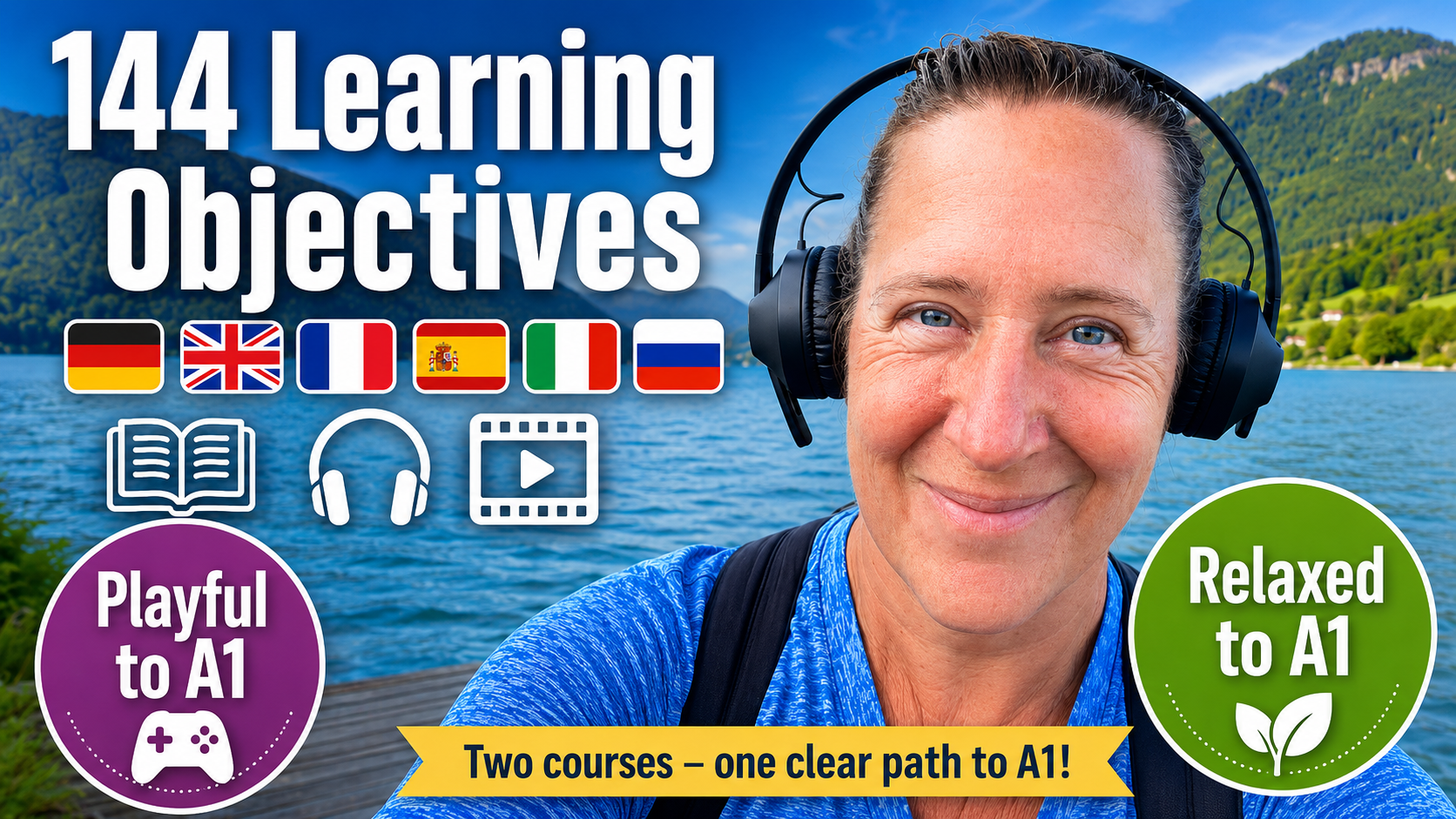
I offer two different language courses designed to help you reach level A1 in a foreign language in as relaxed and playful a way as possible: “Relaxed to A1” and “Playful to A1”.
Both courses teach the important foundations of A1, while at the same time being structured in a way that encourages you to continue learning the language afterwards. That is why some learning objectives already include topics that prepare you for A2 and, in some cases, even B1.
Here you will find the 144 learning objectives that both courses are based on.
The 144 Learning Objectives
- A. First contact with the language – Hear and recognise your first words – Develop a feel for pronunciation and word order
- B. Get to know the verb “to be” – Use the verb “to be” in different situations – Introduce yourself and talk about origin and language
- C. Nouns and their role in the language – Talk about family and origin – Name family members
- D. Describe professions and activities – Name your own and other people’s professions – Describe strengths and weaknesses
- E. Express likes and interests – Talk about hobbies and leisure activities – Express likes and dislikes
- F. Describe cities and places – Introduce a city or place of residence – Compare past and present
- G. Leisure activities and things in common – Name leisure activities – Discover things you have in common with others
- H. Faith, values and respect – Talk about personal beliefs – Express tolerance and respect
- I. Wishes, hopes and dreams – Express wishes – Describe future plans
- J. Personality and character – Describe yourself and others with adjectives – Recognise personality traits
- K. Express opinions and argue a point – Formulate your own views – Discuss alternatives
- L. Make plans for the future – Explain decisions
- A. Ask and answer questions – Use important question words – Ask for information
- B. Time and date – Understand time expressions – Arrange appointments
- C. Numbers and quantities – Use large numbers – Understand prices
- D. Giving directions – Describe places – Give directions
- E. Shopping – Name goods – Compare prices
- F. Food and drink – Order food and drinks – Describe favourite dishes
- G. Eating at a restaurant – Read a menu – Express wishes
- H. House and home – Name rooms and furniture – Compare living situations
- I. Neighbourhood – Get to know people in your surroundings – Use polite forms
- J. Daily routine – Describe activities – Express routines
- K. Clothing and fashion – Name items of clothing – Describe styles
- L. Colours and descriptions – Describe objects – Use colour associations
- A. Weather and seasons – Describe the weather – Choose suitable clothing
- B. Nature and the environment – Describe landscapes – Name natural phenomena
- C. Planning a holiday – Name travel destinations – Choose means of transport
- D. At the airport – Buy tickets – Understand security checks
- E. Hotel and accommodation – Book a room – Make complaints
- F. Sights and attractions – Describe places – Give recommendations
- G. Means of transport – Compare bus, train and car – Understand timetables
- H. At the railway station – Buy tickets and understand platform information – Explain delays
- I. Driving – Explain traffic rules – Understand car rental
- J. In the city – Describe sights and places – Find your way around
- K. Public institutions – Understand the post office, bank and police – Fill in forms
- L. Experiences abroad – Compare cultures – Recognise intercultural misunderstandings
- A. Parts of the body – Understand names and functions – Describe complaints
- B. At the doctor’s – Explain symptoms – Understand medication
- C. Illnesses and injuries – Name common complaints – Seek help
- D. Preventive healthcare – Doctor’s appointments and vaccinations – Healthy lifestyle
- E. Sport and exercise – Name types of sport – Explain the benefits of exercise
- F. Relaxation and stress – Methods of coping with stress – Leisure activities
- G. Nutrition and health – Describe healthy eating – Compare eating habits
- H. Hygiene and personal care – Name personal care products – Describe body care
- I. Sleep and rest – Explain sleeping habits – Describe dreams
- J. First aid – Recognise emergencies – Take action
- K. Disabilities and inclusion – Explain accessibility – Offer support
- L. Medical professions – Name doctors and care workers – Understand hospital vocabulary
- A. School and lessons – Describe everyday school life – Name school subjects
- B. University and studies – Explain degree programmes – Prepare for exams
- C. Applications and CVs – Professions and qualifications – Job interviews
- D. Workplace – Describe tasks and colleagues – Explain work processes
- E. Working hours and salary – Contracts and wages – Compare working hours
- F. Internships and experience – Share professional experience – Describe learning processes
- G. Further education – Courses and training – Lifelong learning
- H. Professions and careers – Explain career choices – Formulate career plans
- I. Self-employment – Describe your own business – Understand business models
- J. Teamwork – Explain collaboration – Roles within a team
- K. Labour market – Trends and changes – Compare occupational groups
- L. Motivation and goals – Set career goals – Define success
- A. Celebrations and public holidays – Describe traditions – Compare celebrations
- B. Music and art – Music genres and artists – Express emotions
- C. Books and literature – Describe favourite books – Name authors
- D. Films and series – Explain film genres – Express opinions
- E. Media and news – Newspapers and the internet – Recognise fake news
- F. Social media – Describe platforms – Discuss advantages and disadvantages
- G. Technology and digitalisation – Name technical devices – Explain changes
- H. History and politics – Understand important events – Express opinions
- I. Migration and integration – Describe reasons and experiences – Discuss challenges
- J. Equality – Explain rights and responsibilities – Equal opportunities
- K. Volunteering and community involvement – Help and support others – Describe social projects
- L. Sustainability – Act in an environmentally responsible way – Discuss measures
- A. Feelings and emotions – Name emotions – Show empathy
- B. Fear and courage – Describe fears – Build self-confidence
- C. Joy and happiness – Share happy moments – Express contentment
- D. Love and relationships – Partnership and family – Resolve conflicts
- E. Friendship – Describe friends – Values in friendship
- F. Communication – Avoid misunderstandings – Active listening
- G. Self-image and identity – Strengths and weaknesses – Self-reflection
- H. Conflicts and solutions – Explain arguments – Find compromises
- I. Motivation and discipline – Set goals – Overcome challenges
- J. Habits – Good and bad habits – Plan changes
- K. Dreams and the future – Formulate visions – Future scenarios
- L. Creativity and inspiration – Develop ideas – Art and expression
- A. Politeness and manners – Distinguish formal and informal language – Make polite requests
- B. Invitations and arrangements – Make suggestions – Coordinate appointments
- C. Requests and wishes – Express wishes – Make polite requests
- D. Apologies and thanks – Apologise – Express gratitude
- E. Telephone conversations – Introduce yourself on the phone – Ask for information
- F. Emails and letters – Write simple messages – Formulations for enquiries
- G. Agreement and disagreement – Agree and disagree – Express opinions politely
- H. Small talk – Start simple conversations – Keep conversations going
- I. Discussions – Formulate arguments – Weigh up advantages and disadvantages
- J. Clarifying misunderstandings – Solve communication problems – Ask clarification questions
- K. Humour and idioms – Understand humorous expressions – Use proverbs
- L. Telling stories – Describe experiences – Build suspense
- A. Countries and cultures – Name countries and their characteristics – Understand cultural differences
- B. Language and dialects – Recognise dialects – Explain language differences
- C. Traditions and customs – Compare celebrations and rituals – Share personal experiences
- D. Religion and worldviews – Describe religions and beliefs – Explain religious festivals
- E. Food cultures around the world – Describe national dishes – Compare eating habits
- F. Economy and money – Prices and currencies – Plan saving and spending
- G. Advertising and consumption – Understand advertising language – Make purchasing decisions
- H. Climate change and the environment – Describe causes and consequences – Discuss sustainable solutions
- I. Human rights and social issues – Explain rights and responsibilities – Discuss equality
- J. Crime and safety – Understand rules and laws – Behaviour in emergencies
- K. Visions of the future – Describe technological developments – Discuss future trends
- L. Science and research – Understand scientific terms – Describe innovations
- A. Renting and moving house – Understand property advertisements – Discuss rental agreements
- B. Tradespeople and repairs – Describe problems in the home – Find solutions
- C. Finances and banks – Conduct conversations at the bank – Open an account and make bank transfers
- D. Insurance and protection – Understand insurance – Assess risks
- E. Traffic accidents and the police – Report accidents – Give witness statements
- F. Emergencies and hospital – Call emergency services – Explain a hospital stay
- G. Shopping abroad – Negotiate prices – Describe markets and shops
- H. Fashion and style – Choose clothing – Describe personal style
- I. Time management – Use time efficiently – Create a daily schedule
- J. Household and organisation – Describe household tasks – Cleaning and household schedules
- K. Pets and nature – Describe animals – Explain responsibility for pets
- L. Sustainable living – Environmentally friendly alternatives – Waste separation and recycling
- A. Social networks – Advantages and disadvantages of social media – Digital etiquette
- B. Digital learning – Online courses and learning methods – Use digital tools
- C. Family and parenting – Describe family values – Compare parenting methods
- D. Interpersonal conflicts – Analyse conflicts – Suggest solutions
- E. Strengthening self-confidence – Recognise your own strengths – Reduce insecurity
- F. Personal development – Set goals – Find motivation
- G. Changes and new beginnings – Overcome challenges – Adapt to new situations
- H. Work-life balance – Cope with stress – Make use of opportunities to relax
- I. Travel as a life experience – Experience travel and cultures – Write travel reports
- J. Minimalism and consumer behaviour – Own less – Make sustainable decisions
- K. Volunteering and social projects – Describe involvement – Share personal experiences
- L. Mental health – Emotional balance – Self-care and mindfulness
- A. Overcoming language barriers – Tips for communication – Reduce language blocks
- B. Humour and cultural differences – Understand jokes – Recognise irony
- C. Compliments and criticism – Give positive feedback – Express criticism politely
- D. Creativity in language – Write your own texts – Wordplay and creative expressions
- E. Dialects and regional expressions – Recognise dialects – Explain language differences
- F. Literature and stories – Read longer texts – Summarise content
- G. Role plays and simulations – Practise everyday situations – Gain confidence in using the language
- H. Test your language level – Recognise progress – Reflect on personal goals
- I. Maintain motivation – Tips for keeping going – Keep enjoying learning
- J. Language tandems and exchange – Speak with native speakers – Find language partners
- K. Intercultural competence – Cultural sensitivity – Understand behaviours
- L. The path to B1 – Plan the next steps – Set language goals
- Protected: 001 Questions about “001 The Sparrow and the Hedgehog in April Weather” – Practise Questions and Answers about the Weather

- Why You Should Be Afraid of “Toxic Foods” – and Why Fear Alone Isn’t Enough

- Protected: 003 of 144 The Sparrow and the Fox Talk about Their Families and Origins While Bowling

- Protected: Room Tour VW Passat – Life in the Car 2023

- Dreamy Tiny House Diary – May 2026


Leave a Reply