


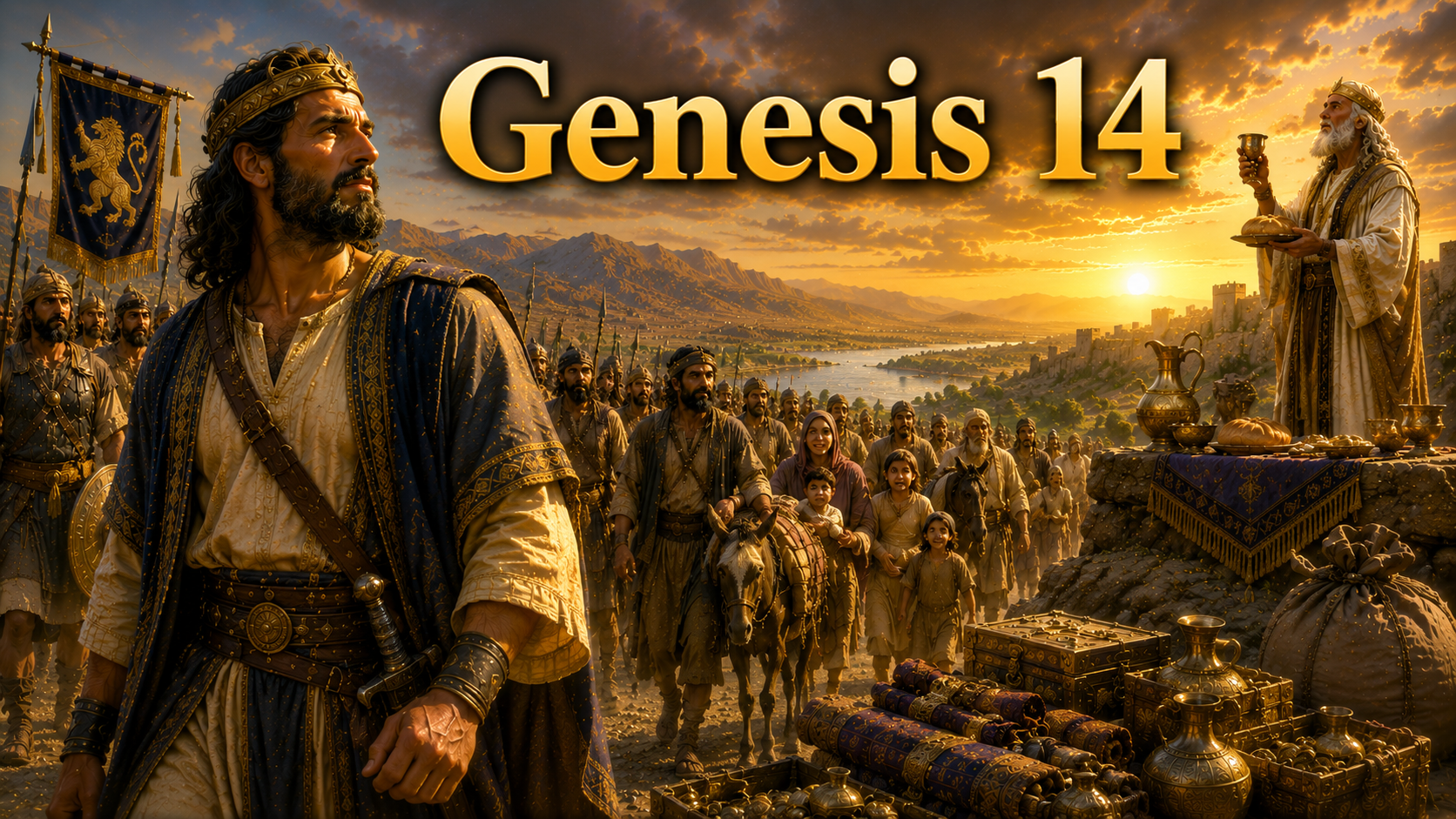
Verse 1
At the time of King Amraphel of Shinar, King Arioch of Ellasar, King Kedorlaomer of Elam, and King Tidal of Goiim, a war broke out against the kings of Sodom, Gomorrah, Admah, Zeboiim, and Bela.
This verse introduces the kings involved and shows that the following events take place during a real historical conflict. The Bible names these rulers to place the story in its historical setting.

Verse 2
The four kings went to war against the five kings of the cities in the Jordan Valley.
This conflict sets the stage for everything that follows. Its consequences will soon affect Abram and his nephew Lot.

Verse 3
The five kings gathered together in the Valley of Siddim, where the Dead Sea is today.
The Bible identifies the exact location of the battle. This reminds us that these events took place in real places with real people.

Verse 4
For twelve years the five kings had served Kedorlaomer, but in the thirteenth year they rebelled against his rule.
Their rebellion triggered the war. Political decisions often have far-reaching consequences for many people.

Verse 5
In the fourteenth year, Kedorlaomer and his allies marched out and defeated several peoples, including the Rephaites, the Zuzites, and the Emites.
This campaign demonstrated the military strength of the four kings. No nation seemed able to stand against their army.

Verse 6
They also defeated the Horites in the hill country of Seir as far as El Paran near the wilderness.
The invading army continued its victorious advance. Step by step, it conquered more and more territory.

Verse 7
Then they turned back to Kadesh and defeated the Amalekites as well as the Amorites living in Hazezon Tamar.
Before the decisive battle even began, the four kings had already won many victories. Their army had become greatly feared.

Verse 8
Then the kings of Sodom, Gomorrah, Admah, Zeboiim, and Bela marched out for battle.
The five kings decided to confront their enemies. Now the decisive battle was about to begin.

Verse 9
Four kings fought against five kings in the Valley of Siddim.
Although the five kings seemed to have the advantage in numbers, victory would not be decided by numbers alone.

Verse 10
The Valley of Siddim was full of tar pits. The kings of Sodom and Gomorrah were defeated. Some fell into the pits, while the rest fled into the hills.
The defeat was complete. Many survived only by escaping into the mountains.

Verse 11
The victors took all the possessions and all the food from Sodom and Gomorrah.
War brought not only destruction but also plundering. The people lost everything they owned.

Verse 12
Lot, Abram’s nephew, was also taken captive together with all his possessions because he was living in Sodom.
Lot became involved in the war even though he had not chosen to fight. His decision to live in Sodom had serious consequences.

Verse 13
A survivor escaped and told Abram that Lot had been captured. Abram was living near the great trees of Mamre and was allied with Mamre, Eshkol, and Aner.
God had not left Abram alone. Faithful friends and allies can be a great help in difficult times.

Verse 14
When Abram heard that Lot had been taken captive, he gathered the 318 trained men born in his household and pursued the enemy as far as Dan.
Abram acted immediately. Instead of giving in to fear, he accepted responsibility for his family.

Verse 15
During the night Abram attacked the enemy by surprise, defeated them, and pursued them as far as Hobah, north of Damascus.
Abram won through a wise strategy. God can accomplish great things even through a small group of faithful people.

Verse 16
Abram recovered all the possessions. He also rescued Lot, his family, and all the other captives.
Abram’s courage brought freedom to many people. His actions were motivated by love and responsibility.

Verse 17
After the victory, the king of Sodom came out to meet Abram in the King’s Valley.
Abram’s victory did not go unnoticed. Soon he would meet someone even more significant.

Verse 18
Melchizedek, king of Salem and priest of God Most High, brought out bread and wine.
Melchizedek is one of the Bible’s most remarkable figures. For Christians, the bread and wine later point to Jesus Christ.

Verse 19
Melchizedek blessed Abram in the name of God Most High, the Creator of heaven and earth.
This blessing makes it clear that God was the source of Abram’s victory. All glory belongs to the Creator.

Verse 20
Melchizedek praised God for the victory, and Abram gave him a tenth of everything.
Abram expressed his gratitude to God. Giving a tenth was a sign of worship, trust, and thankfulness.

Verse 21
The king of Sodom asked Abram to return the people while keeping all the possessions for himself.
The offer sounded generous, but Abram was not interested in personal gain.

Verse 22
Abram raised his hand to the Lord, God Most High, the Creator of heaven and earth.
By making this oath, Abram declared that his trust belonged to God alone.

Verse 23
Abram declared that he would accept nothing from the king of Sodom—not even a thread or the strap of a sandal.
No one would ever be able to claim that they had made Abram wealthy. His blessings came from God alone.

Verse 24
Only Abram’s allies were to receive their rightful share. Abram himself accepted nothing.
Abram acted with honesty and fairness. He allowed others to receive what was rightfully theirs while refusing to enrich himself.

- Protected: 001 Questions about “001 The Sparrow and the Hedgehog in April Weather” – Practise Questions and Answers about the Weather

- Why You Should Be Afraid of “Toxic Foods” – and Why Fear Alone Isn’t Enough

- Protected: 003 of 144 The Sparrow and the Fox Talk about Their Families and Origins While Bowling

- Protected: Room Tour VW Passat – Life in the Car 2023

- Dreamy Tiny House Diary – May 2026


Leave a Reply