


Would you like to get involved in social causes together with an acquaintance and help people in need? But which people are most urgently in need of support? Would you prefer to donate money or get personally involved? Which charitable organisations could you consider, how much time could you invest each week, and on which days would you be available?
Perhaps you could volunteer at a food bank, Caritas, the German Red Cross or the Bahnhofsmission (station mission). Or would it be better to organise your own charity initiative?
In this B1 dialogue, you will learn how to make suggestions, express your opinion, compare different options, weigh up advantages and disadvantages, find compromises and plan a social project together.
You need these skills not only in everyday life but also for the B1 speaking examination, for example in the section “Planning Something Together”.
Dialogue: Julia and Sandra Want to Get Involved in Social Causes Together
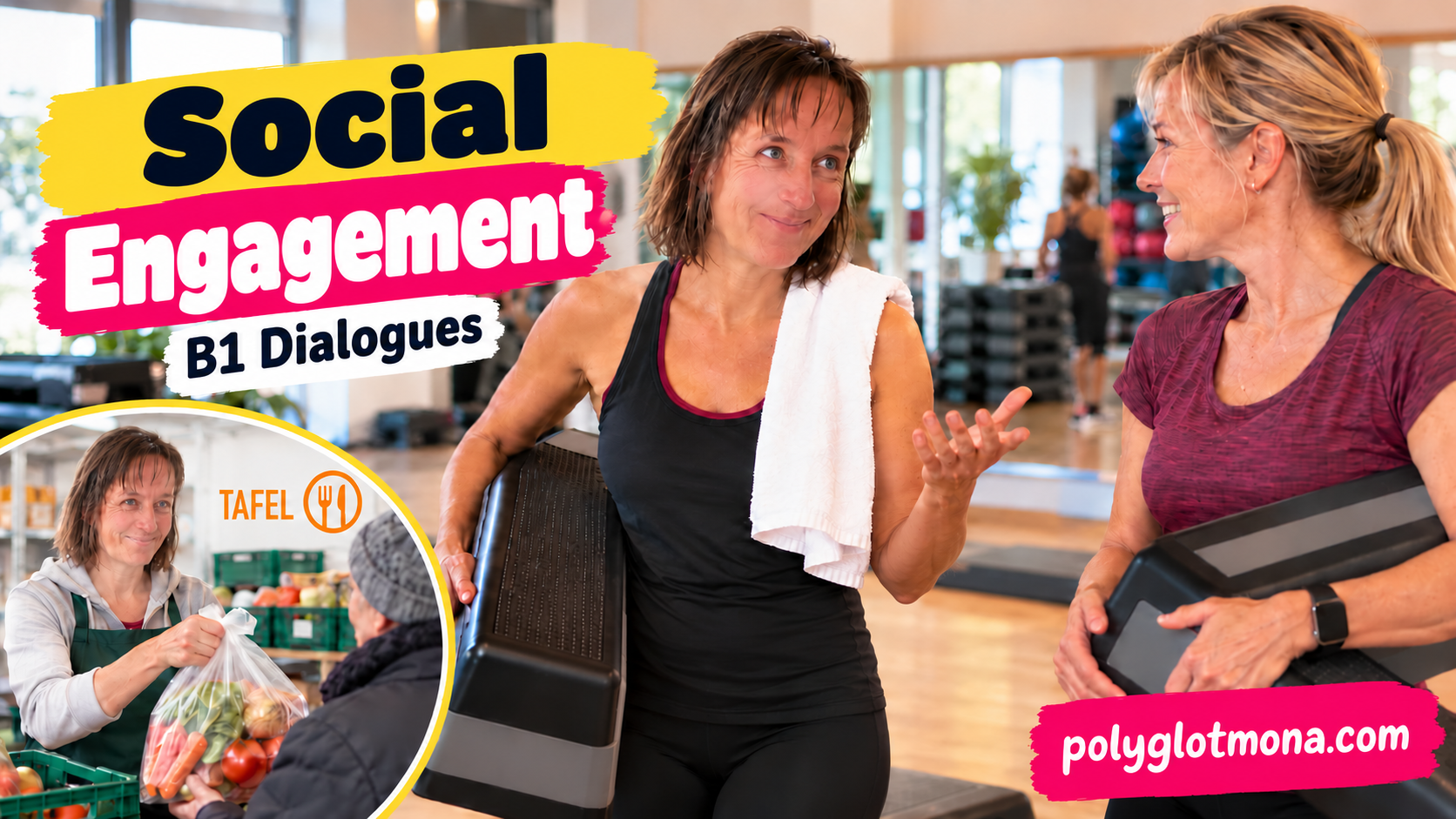
Julia and Sandra know each other from a step aerobics class that they attend every Tuesday. After their workout, they talk about how they could support people in difficult circumstances.
Julia: Sandra, do you have a few more minutes? Lately, I’ve been thinking a lot about people who are struggling financially. I’d really like to do something to help them.
Sandra: I think that’s a great idea! I’ve also been thinking about doing some volunteer work. What exactly did you have in mind?
Julia: At first, I was thinking about donating money regularly. Perhaps we could support a charitable organisation together.
Sandra: In principle, I think that’s a good idea. However, I don’t earn very much, so unfortunately I can’t afford to make large donations. I’d rather help out in person.
Julia: I understand. You don’t necessarily have to donate money to do something good. Which people would you most like to support?
Sandra: I’m particularly concerned about people affected by poverty. For example, families who don’t have enough money for food or older people living on a small pension.
Julia: I especially care about people experiencing homelessness. I imagine their situation must be particularly difficult in winter. Perhaps we could organise something for people without a permanent home.
Sandra: That would make sense. However, many other people also need support. Perhaps we should first find out what kinds of assistance are available in our city.
Julia: Good idea! I know about the Tafel food banks. They collect food and distribute it to people who have very little money.
Sandra: That’s right. There are also Caritas, the German Red Cross and the Bahnhofsmission. But I don’t know exactly what opportunities they offer for volunteers.
Julia: We could quickly look it up online. I’ve got my phone with me. Just a moment … I’ll search for “volunteering at Tafel”.
Sandra: And what does it say?
Julia: The website says that volunteers can, for example, collect, sort and distribute food. You can contact a local Tafel food bank directly to find out more.
Sandra: That sounds interesting! I’d like to help distribute food and have personal contact with the people.
Julia: I’ll also look up the Bahnhofsmission. It says here that they support people in need and travellers. You can volunteer there too.
Sandra: That might suit us as well. Perhaps we should contact both organisations and find out where help is currently needed.
Julia: Agreed. But what do you think about organising our own charity initiative? We could, for example, collect warm clothes and pass them on to a social welfare organisation.
Sandra: I like the idea. However, organising everything ourselves would probably involve quite a lot of work. We’d have to collect donations, sort the clothes and find a suitable organisation.
Julia: You’re right. Besides, the staff at the charitable organisations know better what is actually needed.
Sandra: Exactly. That’s why I’d suggest joining an existing organisation first. We could always plan our own initiative later.
Julia: You’ve convinced me. Now we should think about how much time and money we can invest. I could donate about 30 euros a month and also volunteer for two hours a week.
Sandra: That’s generous of you. I could donate a maximum of five euros a month, but I’d have about four hours a week available.
Julia: That’s wonderful! Each of us can help according to her own circumstances. You really don’t need to feel bad about that.
Sandra: Thank you! It would be important to me to volunteer regularly rather than just do something once.
Julia: I feel the same way. Which days would you be available?
Sandra: I work late on Mondays and Thursdays. On Tuesdays, we have our step aerobics class. But I’d be free on Wednesdays from 4 p.m. and on Saturday mornings.
Julia: I have to look after my mother on Wednesdays. However, I could help on Saturdays from 9 a.m. to 12 noon. Would that suit you?
Sandra: Yes, perfectly. Then we could plan about three hours every Saturday. Of course, if the organisation has different volunteering hours, we’d have to discuss it again.
Julia: Exactly. And how would we get there? I do have a car, but I’d rather use public transport if the organisation is easy to reach.
Sandra: I’d prefer that too. I’ve already got a Deutschlandticket anyway. We could meet at a bus stop and travel there together.
Julia: Perfect! But before we make a final decision, we should ask whether they actually need volunteers on Saturdays.
Sandra: Agreed. I could call the Tafel tomorrow and ask about the tasks, volunteering hours and requirements.
Julia: Then I’ll write an email to the Bahnhofsmission and ask whether they need support on Saturday mornings.
Sandra: Good! And what about your idea of donating money?
Julia: I could set up a monthly standing order for 30 euros. But first, I’d like to know what the organisation uses the money for.
Sandra: I think that’s sensible. Perhaps we could also organise a fundraising event at our sports club once a year.
Julia: Oh, that’s a lovely idea! We could ask our instructor whether we could organise a small collection for a good cause at the club.
Sandra: Exactly. But first, let’s concentrate on regular volunteer work. We shouldn’t start too many things at once.
Julia: You’re right. So, let’s summarise: we’ll contact the Tafel and the Bahnhofsmission, compare the options and then choose an organisation.
Sandra: And if everything works out, we’ll volunteer for about three hours on Saturdays. You’ll also donate 30 euros a month, and I’ll try to contribute five euros every month.
Julia: Exactly. We’ll also ask our instructor about a possible fundraising event. Shall we sit down together again after training next Tuesday and share the information we’ve gathered?
Sandra: I’d love to! Hopefully, by then, we’ll know which organisation could use our help.
Julia: It’s a deal! I’m looking forward to it. It’s nice when you can do something meaningful together.
Sandra: I think so too. And who knows? Perhaps we can inspire more people from our sports class to get involved!
Important Vocabulary: Social Engagement
social engagement – voluntarily taking action to help other people or contribute to society
to get involved – to take action and support a particular cause
voluntarily / as a volunteer – willingly and usually without payment
volunteer work – an activity carried out voluntarily, usually without payment
a charitable organisation – an organisation that supports people in difficult circumstances
people in need – people who need financial or other forms of assistance
to be affected by poverty – to have so little money that it is difficult to meet basic needs
homeless – without a permanent place to live
a monetary donation – money given voluntarily to support a good cause
a donation of goods – an item donated to someone, such as clothing or food
a standing order – an instruction to a bank to transfer money regularly
to distribute food – to give food to people who need it
the Tafel food bank – a non-profit organisation in Germany that rescues surplus food and distributes it to people affected by poverty
the Bahnhofsmission (station mission) – a social welfare service in Germany that helps travellers and people in need, among others
Caritas – a Catholic welfare organisation that supports people in various circumstances
the German Red Cross (DRK) – a humanitarian organisation that provides social and humanitarian assistance, among other services
a fundraising event – an organised activity in which donations are collected
a requirement – a condition that must be fulfilled
a volunteering assignment – an activity in which someone actively helps
volunteering hours – the times when someone works voluntarily
to enquire about something – to obtain information about something
to join an organisation – to become a member or volunteer of an organisation
to get something off the ground – to organise or successfully establish something
to find a compromise – to find a solution that everyone involved can agree on
something is close to my heart – something is personally very important to me
according to one’s means – in a way that suits one’s available time, money or personal circumstances
to inspire someone to do something – to make someone very interested in or enthusiastic about an activity
Useful Expressions for the B1 Examination
Making Suggestions
How about getting involved in volunteer work together?
I suggest that we contact the Tafel.
What do you think about organising a fundraising event?
We could help people in need once a week.
Perhaps it would make sense to do some research online first.
Asking for Someone’s Opinion
What do you think about that?
Which people would you like to support?
How do you like my suggestion?
Would that be okay with you?
Which organisation would you prefer?
Agreeing
I think that’s a good idea.
I agree with that.
That sounds really sensible.
You’re absolutely right.
I feel exactly the same way.
Disagreeing Politely
I’d rather help out in person.
That’s a good idea, but I can’t afford to donate that much money.
I’m not sure whether we’d have enough time for that.
Could we support an existing organisation instead?
I understand your suggestion, but I see a problem with it.
Finding a Compromise
Perhaps we could donate money and volunteer at the same time.
Then let’s agree on Saturday mornings.
Each of us could contribute according to her own circumstances.
We could contact two organisations first and then decide.
That would be a good compromise.
Dividing Up Tasks
I’ll take care of contacting the Tafel.
Could you gather information about the Bahnhofsmission?
I’ll write an email to the charitable organisation tomorrow.
You could ask about the volunteering hours.
We should divide up the tasks.
Making a Decision Together
Then let’s do it that way.
We can agree on that.
We’ve decided that we’d like to help on Saturdays.
Let’s talk about it again next Tuesday.
That settles our provisional plan.
Grammar in the Dialogue
The Subjunctive II for Polite Suggestions
In German, the subjunctive II is used to express wishes, possibilities and suggestions particularly politely.
We could help people in need together.
I would rather volunteer at the Tafel.
Would you have time on Saturday?
Would that be okay with you?
Perhaps we should get some information first.
Subordinate Clauses with “because”, “if”, “although” and “that”
These conjunctions help you form longer and more varied sentences. In German, the conjugated verb comes at the end of the subordinate clause.
I want to volunteer because I don’t earn very much money.
If we have time on Saturdays, we could distribute food together.
Although Julia would like to donate money, she is also interested in volunteer work.
I think it’s good that we want to support people in need.
The Infinitive with “to”
In German, many verbs and expressions are followed by an infinitive construction with “to”, which corresponds to the English infinitive with “to” in many sentences.
I intend to donate money regularly.
It is important to support people in need.
We are trying to find a suitable charitable organisation.
Sandra would like to help out at the Tafel.
Please note: In German separable verbs, the infinitive marker is placed between the separable prefix and the verb stem.
to help out → to help out
to participate → to participate
The Infinitive with “in order to”
In German, an infinitive construction corresponding to “in order to” is used to express a goal or purpose.
We volunteer in order to help people in need.
Julia wants to donate money in order to support a charitable organisation.
Sandra searches online in order to find information about volunteer activities.
In German, when using this infinitive construction, the person or group performing the action must be the same in the main clause and the infinitive construction. If the people performing the actions are different, a subordinate clause expressing purpose is often used instead.
Julia donates money so that the organisation can help people in need.
Exercises on the Dialogue – B1 Level
Complete the following exercises with as little help as possible. Read the dialogue again if necessary.
Exercise A: Reading Comprehension
Answer the questions in complete English sentences.
Question 1: How do Julia and Sandra know each other?
Question 2: Why does Julia want to support people in need?
Question 3: Why would Sandra rather volunteer than donate larger amounts of money?
Question 4: Which people does Sandra particularly want to support?
Question 5: Which group of people is especially close to Julia’s heart?
Question 6: Which four charitable organisations are mentioned in the conversation?
Question 7: What information do the two women find online?
Question 8: Why don’t they want to organise their own charity initiative at first?
Question 9: How much money and time can Julia and Sandra each invest?
Question 10: On which day of the week would the two women like to volunteer?
Question 11: How would they normally like to travel to their volunteering location?
Question 12: Which tasks will Julia and Sandra take on before their next meeting?
Exercise B: True or False?
Decide whether the statements are true or false. Correct the false statements.
Statement 1: Julia and Sandra know each other from a language course.
Statement 2: Julia initially wants to donate money regularly.
Statement 3: Sandra earns a lot of money and therefore wants to donate 100 euros a month.
Statement 4: Sandra particularly wants to support families and older people who have very little money.
Statement 5: Julia is especially interested in supporting people experiencing homelessness.
Statement 6: The two women research information online during their conversation.
Statement 7: Julia and Sandra immediately decide to establish their own charitable organisation.
Statement 8: Julia could donate about 30 euros a month.
Statement 9: The two women have decided to volunteer for three hours every Wednesday.
Statement 10: Julia writes an email to the Bahnhofsmission.
Exercise C: Fill in the Missing Words
Use these words: voluntarily – monetary donation – Tafel – people in need – volunteering hours – fundraising event – compromise – organisation – food – get involved
Sentence 1: I would like to __________ in social causes because I want to help other people.
Sentence 2: Someone who works willingly and without payment is working __________.
Sentence 3: The __________ supports people affected by poverty by providing food.
Sentence 4: People who urgently need help are also called __________.
Sentence 5: Julia would like to make a monthly __________.
Sentence 6: We still need to ask which __________ are available for volunteers.
Sentence 7: We could organise a __________ at our sports club.
Sentence 8: At the Tafel, donated __________ is sorted and distributed.
Sentence 9: We should find a suitable __________ before we register.
Sentence 10: When we have different ideas, we need to find a __________.
Exercise D: Grammar – Subjunctive II
Complete the sentences with the appropriate form of “can”, “have”, “be” or “would”.
Sentence 1: __________ you like to get involved in volunteer work with me?
Sentence 2: We __________ help out at the Tafel on Saturday.
Sentence 3: I __________ rather donate my time than money.
Sentence 4: __________ it be okay with you if we helped on Saturdays?
Sentence 5: Perhaps we __________ organise a fundraising event first.
Sentence 6: If I were you, I __________ contact the charitable organisation first.
Sentence 7: __________ you have three hours available on Saturday morning?
Sentence 8: It __________ be lovely if we could do something good together.
Exercise E: Combine the Sentences
Combine the two sentences using the conjunction given. Pay attention to word order.
Sentence 1: Sandra wants to volunteer. She doesn’t earn very much money. (because)
Sentence 2: We have time on Saturday. We can help out at the Tafel. (if)
Sentence 3: Julia wants to donate money. She also wants to help in person. (although)
Sentence 4: Sandra is happy. Julia also wants to get involved in social causes. (that)
Sentence 5: The organisation needs volunteers. We register there. (if)
Sentence 6: We support the Bahnhofsmission. We want to help people in need. (because)
Exercise F: Make the Sentences More Polite
Use the subjunctive II or another polite expression.
Sentence 1: We are helping at the Tafel on Saturday.
Sentence 2: You must call the Bahnhofsmission.
Sentence 3: We donate 30 euros every month.
Sentence 4: I want to do volunteer work instead.
Sentence 5: You get information about the volunteering hours.
Sentence 6: We are organising a fundraising event.
Exercise G: Put the Dialogue in the Correct Order
Arrange the statements to create a logical conversation.
A. Good idea! Then I’ll take care of arranging a trial volunteering session.
B. I’d like to get involved in volunteer work. Would you like to join me?
C. I’d have about three hours available on Saturday morning.
D. Yes, I’d love to! Which organisation would you like to support?
E. That suits me too. Then we should enquire about the volunteering hours.
F. Perhaps we could help at the Tafel.
G. That sounds interesting. When would you be available?
Exercise H: Correct the Mistakes
Each sentence contains at least one grammatical mistake. Rewrite the sentences correctly.
Sentence 1: I want to volunteer because I don’t earn not very much money.
Sentence 2: We could to help together on Saturday.
Sentence 3: If we will have time, we can work at the Tafel.
Sentence 4: I would rather donating my time.
Sentence 5: Although Julia wants donating money, she also wants to help in person.
Sentence 6: We have decided that we helping every Saturday.
Sentence 7: Sandra intends helping at a charitable organisation.
Sentence 8: I volunteer in order I can support people.
Exercise I: Write Your Own Sentences
Write at least one appropriate sentence at B1 level for each situation.
Situation 1: You would like to suggest to your acquaintance that you volunteer together at a charitable organisation.
Situation 2: Your acquaintance suggests donating 50 euros a month, but you cannot afford it.
Situation 3: You would rather help people in person than donate money. Explain your opinion politely.
Situation 4: Your acquaintance wants to volunteer on Mondays, but you don’t have time. Suggest another day.
Situation 5: You would like to know which charitable organisations exist in your city.
Situation 6: You would like to clarify how you could get to your volunteering location.
Situation 7: You want to organise a fundraising event, but your acquaintance thinks it would involve too much work. Find a compromise.
Situation 8: You would like to suggest contacting the Tafel and the Bahnhofsmission first.
Exercise J: B1 Writing Task
Your acquaintance has sent you a message:
Hello! I’ve been thinking that I’d like to get involved in social causes. Perhaps we could support people in need together. But I don’t know yet whether we should donate money or volunteer. Do you have any ideas? We could make a plan next week. What do you think?
Write a reply of approximately 80 to 100 words. Address the following points:
Point 1: Which people would you like to support?
Point 2: Would you prefer to donate money or help in person?
Point 3: Which charitable organisation or independent initiative would you suggest?
Point 4: How much time or money could you invest?
Point 5: When could you meet to discuss everything in more detail?
Exercise K: Speaking Task – Planning Something Together
Imagine that you are taking an oral B1 examination.
You and your conversation partner know each other from a sports class. You would like to get involved in social causes and support people in need.
Discuss the following points together:
Point 1: Which people would you like to support?
Point 2: Would you like to donate money, collect goods or help in person?
Point 3: Would you prefer to join an existing charitable organisation or organise your own initiative?
Point 4: Which organisations could you consider?
Point 5: How much time and money can each of you invest?
Point 6: On which days and at what times would you like to volunteer?
Point 7: How will you get to the volunteering location?
Point 8: Who will take responsibility for which preparation tasks?
Point 9: How could you inspire other people to support your project?
Try not only to explain your own suggestions but also to ask your conversation partner for her opinion. Respond to her ideas, explain your opinion and find a solution together.
At the end of your conversation, you should reach a concrete agreement.
Model Answers to the Exercises
Would you like to check your answers and find out whether you completed the exercises correctly?
There is a separate article containing the complete model answers to all the exercises. This article is password-protected.
For my students: You can get the password from me free of charge.
For everyone else: You can purchase the password for a one-time payment of €0.50 via PayPal.
This allows you to practise independently first and then compare your answers with the model answers.
More Dialogues? Discover “Relaxed to B1”!
Would you like to read more dialogues while expanding your German vocabulary?
Then discover my language course “Relaxed to B1”!
In an ongoing novel, you’ll meet engaging characters and experience numerous everyday situations with them. Through natural conversations, you’ll learn new words and expressions in context.
You can expand your vocabulary, revise important grammar, improve your reading comprehension and prepare step by step for everyday conversations as well as the B1 examination.
Learning German can be exciting and relaxing at the same time!


Leave a Reply