


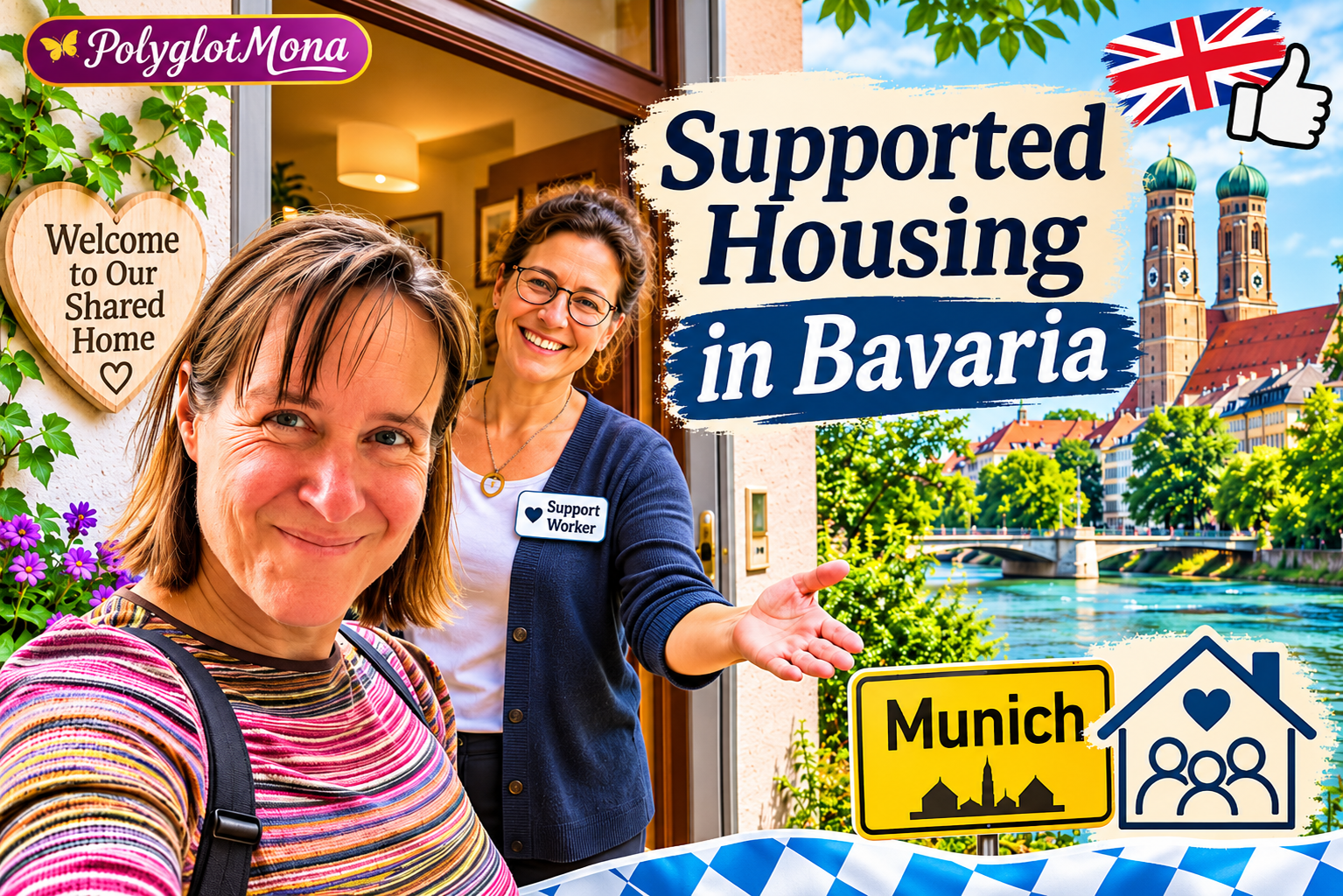
From personal experience, I know what it feels like when life falls apart and you need support.
I, too, spent some time living in a supported shared home for people with mental health conditions.
At that time, I was dealing with several serious personal crises and was grateful that I did not have to manage everything on my own.
Later, I worked in a residential facility for people with mental health conditions, first as an overnight support worker and then as a care worker.
I also studied psychology for four semesters and educational sciences for four semesters because I have always been interested in how the human mind works, how we cope with stress and what helps us overcome difficult situations in life.
I therefore know supported housing from three perspectives: as a former resident, as a member of staff and through my studies of psychological and educational principles.
Supported housing can offer much more than a roof over your head and occasional assistance with everyday tasks.
It can help people rediscover their strengths, develop new resources, build resilience – their ability to cope with psychological challenges – and gradually regain confidence in their own abilities.
Going through a difficult period in life does not necessarily mean that you will always need support.
Sometimes, deciding to accept temporary help is the first step towards a more independent life.
That is why I would like to show you which supported housing options are available, what everyday life in these facilities can look like and where you can find support in Munich and throughout Bavaria.
Accepting help is not a personal failure.
It can be a courageous and sensible decision that allows you to emerge from a crisis with renewed strength, greater self-confidence and stronger resilience.
1. Living Independently – What Outpatient Support Is Available to You?
Not everyone experiencing mental health difficulties needs to live in supported shared accommodation.
Perhaps you already have your own home, manage everyday life reasonably well and simply wish you had someone to talk to regularly about your difficulties.
In that case, there are several ways to receive support without giving up your home.
Psychotherapy and Psychiatric Treatment
One option is outpatient psychotherapy.
For example, you might arrange an appointment with a psychotherapist once a week.
During these sessions, you can talk about your thoughts, feelings, stress and difficulties and work together on making changes.
If necessary, you can also consult a psychiatrist.
There, you can discuss whether medication might be helpful and how your health is developing.
The frequency of appointments depends on your individual needs.
Social Psychiatric Services (Sozialpsychiatrischer Dienst – SpDi)
If you are unsure what kind of support you need, the Social Psychiatric Service is an important first point of contact.
You can talk to the staff about psychological stress, loneliness, family problems, difficulties in everyday life or the risk of losing your home.
The staff can advise you and help you find suitable additional services.
Counselling is generally free of charge.
You can contact a Social Psychiatric Service even if you have not received a specific psychiatric diagnosis.
Day Centres – Social Contact and Daily Structure
Perhaps you find it difficult to get up in the morning, organise your day meaningfully or maintain regular contact with other people.
A psychosocial day centre can help you with these challenges.
Depending on the facility, activities may include shared meals, creative workshops, conversations, occupational activities and leisure programmes.
You can continue living in your own home and attend the day centre at agreed times.
Day Hospitals – Treatment During the Day, Sleeping at Home
A psychiatric or psychosomatic day hospital provides more intensive medical and therapeutic treatment.
You normally spend several hours there during the day and return home afterwards.
Treatment may include individual and group therapy, occupational therapy, medical consultations and other therapeutic services.
A day hospital is therefore different from a day centre.
It is a partial hospitalisation programme and requires an appropriate medical indication.
Everyday Assistance for People with an Assessed Care Level
An everyday support worker can also help you if you want to continue living independently.
Perhaps you need someone to accompany you shopping, go for walks with you, help you with everyday tasks or simply keep you company.
If you have an officially recognised care level (Pflegegrad), you may be able to use the relief allowance provided by German long-term care insurance under certain conditions.
This allowance amounts to €131 per month.
In Bavaria, registered individuals working on a voluntary basis can also provide certain everyday support services.
For example, with an expense allowance of €11 per hour, the monthly budget would cover almost twelve hours of assistance.
The costs may be reimbursed by the long-term care insurance fund if the applicable requirements are met.
It is important to remember that not every privately arranged support service is automatically eligible for reimbursement.
You can find further information on the official Bavarian website about everyday assistance provided by individuals.
Everyday Assistance Provided by Individuals in Bavaria
2. What Types of Supported Housing Are Available?
Supported housing does not automatically mean that someone constantly monitors what you do.
Some types of accommodation provide very little support, while others have staff available around the clock.
Which option suits you depends on how independently you can live, what support you need and what personal goals you have.
Supported Independent Living
With supported independent living, you live in your own home.
A support worker visits you regularly and helps you, for example, with household management, dealing with authorities, financial difficulties or building social contacts.
Support is provided according to an individually agreed plan.
You can organise your daily routine largely independently.
However, it is important to know that many supported independent living providers do not arrange accommodation but instead support you in a home you already have.
Supported Shared Housing with a Lower Level of Assistance
If you enjoy living independently but often feel lonely, supported shared accommodation might be an interesting option.
You normally have your own room and share facilities such as the kitchen, bathroom or living room with other residents.
You can retreat to your room when you need peace and quiet and spend time with others when you want company.
A support worker is available at agreed times.
Depending on the facility, there may be shared discussions or activities.
Some shared homes require only a few fixed appointments, while others provide a more structured daily routine.
Therapeutic Shared Housing
Therapeutic shared housing often provides more regular support.
There may be individual conversations, group meetings, shared activities and compulsory household responsibilities.
The aim is to maintain or further develop your independence.
However, not every therapeutic shared home provides psychotherapy in the medical sense.
The exact support services and admission requirements vary from one facility to another.
Shared Housing with an External Daily Programme
Some supported shared homes require residents to take part in regular activities outside the accommodation during the day.
This might involve employment, attending a workshop for people with disabilities or visiting a day centre.
Support is then mainly provided in the afternoons, evenings or at night.
This type of accommodation can be particularly suitable for people who already have a regular daily routine.
Special Residential Settings with Intensive Support
Some people need considerably more assistance.
In such cases, special residential settings funded through German integration assistance services (Eingliederungshilfe) may be an option.
Depending on the facility, there may be regular support, overnight on-call staff, waking night staff or continuous staff presence.
Residents receive assistance according to their individual needs.
Shared Housing with Outpatient Nursing Care
Shared housing with nursing support is primarily intended for people who need assistance with personal care or nursing.
These homes are often designed for older people or individuals with physical or cognitive impairments.
Not every nursing shared home is suitable for people with mental health conditions or addictions.
You should therefore always ask about the target group and admission requirements.
3. My Personal Experience in a Supported Shared Home in Garmisch
When I lived in a supported shared home in Garmisch, I was going through a difficult period in my personal life.
I had lost the custody proceedings concerning my children and was also dealing with problems in my relationships at the time.
In this situation, I decided to move into supported shared accommodation.
We had two female support workers and approximately five scheduled group activities each week.
The programme included morning exercise, discussion groups and shared excursions.
Occasionally, we even went on short holidays together.
Once a week, we had breakfast together.
Every resident also had certain household responsibilities.
These might include vacuuming the staircase or emptying the dishwasher.
The tasks were reassigned every week.
The residents were in very different situations in life.
Some were already retired and no longer employed.
As far as I remember, another resident worked approximately 30 hours a week in a social second-hand shop.
Some residents also had a history of drug-related problems.
As far as I recall, consuming alcohol or drugs inside our building was not permitted.
What I particularly appreciated was that one of our two support workers was available during the day.
If you were worried about something or did not know how to handle a particular situation, you did not have to face it alone.
Living with the other residents could also be very helpful.
We could talk, do things together or simply spend time in each other’s company.
At the same time, everyone could retreat to their own room when they wanted privacy.
Of course, there were disadvantages too.
The regular group meetings limited our freedom to organise our own schedules.
Especially if you were employed, you had to make sure that your work commitments were compatible with the compulsory activities.
This worked well for me because I was giving private lessons.
I could schedule my tutoring sessions on afternoons when there were no group meetings.
Looking back, I do not consider this period of my life a personal failure.
Instead, it was an opportunity to receive support during a difficult time while maintaining my independence.
4. My Experience as an Overnight Support Worker and Care Worker
Later, I became familiar with a different form of supported housing.
I initially worked as an overnight support worker in a residential facility for people with mental health conditions.
My shift started at 7 p.m. and ended at 7 a.m.
During the night, I slept in a staff room.
Normally, I did not have to work actively but simply needed to be available if a resident required assistance.
From Monday to Friday, residents were required to attend regular activities outside the building between 7 a.m. and noon.
This might involve attending a day centre, working in a workshop for people with disabilities or going to another workplace.
During these hours, there were normally no psychologists, social workers or specialist disability support workers in the building.
Sometimes, I stayed longer in the morning, for example when a resident was ill and needed to remain at home.
Occasionally, I also took on other tasks, such as helping when the cleaner was absent.
Eventually, my manager told me that he would like me to work during the day.
As a result, I began training in specialist support and care for people with disabilities (Heilerziehungspflege).
Unlike my former shared home in Garmisch, this facility had considerably fewer scheduled group meetings.
For example, we organised a shared television or film evening and occasional other group activities.
Personal conversations were an important part of our work.
We helped residents organise their households, improve their personal hygiene and establish or maintain social relationships.
Sometimes, we also discussed how someone could live more independently in the future.
For some residents, the next step was moving into supported independent living.
This experience showed me how differently supported housing can be organised.
Not everyone needs the same level of assistance or the same number of group meetings.
5. Supported Housing for Alcohol Dependence and Other Addictions
If you are dependent on alcohol or have another addiction, you should pay particular attention to the admission requirements.
Many therapeutic shared homes follow an abstinence-oriented approach.
This means that you must already be abstinent before admission or that abstinence is a compulsory goal of the facility.
Some services are specifically intended for people who have completed addiction rehabilitation treatment.
If you are still drinking alcohol, these facilities may not be suitable for you.
However, there are also low-threshold and consumption-tolerant housing services.
In these facilities, continued alcohol consumption is not necessarily a reason for exclusion.
Nevertheless, this does not mean that there are no rules.
Even consumption-tolerant facilities may prohibit violence, threats or behaviour that endangers other residents.
Before applying, you should therefore clarify the following questions:
- Do I already have to be abstinent?
- Am I allowed to continue drinking alcohol?
- What rules apply to alcohol consumption inside the facility?
- What happens if I relapse?
- How many group meetings are compulsory?
- Will I have a designated support worker?
- Can I continue working?
- How long am I allowed to live there?
What Does Dual Diagnosis Mean?
The term dual diagnosis is often used when a person has both a mental health condition and a substance use disorder.
For example, someone may experience both depression and alcohol dependence.
Anxiety disorders, psychotic disorders and other mental health conditions can also occur alongside addiction.
People in this situation need services that take both conditions into account.
Not every psychiatric shared home accepts people with an active addiction.
Conversely, not every addiction support facility specialises in additional severe mental health conditions.
Individual counselling can help you identify suitable services.
6. Additional Support – You Do Not Have to Manage Everything Alone
Not every form of support requires you to move home.
Perhaps you simply need more social contact, regular conversations or help with certain tasks.
In addition to the medical and social psychiatric services already described, there are other possibilities.
Self-Help Groups and Community Centres
Self-help groups allow you to exchange experiences with people who have faced similar challenges.
There are groups for people experiencing depression, anxiety disorders, addictions and for relatives of people with mental health conditions.
Community centres and neighbourhood meeting places also provide opportunities to meet new people.
Clubs and Voluntary Activities
Perhaps you would like to go walking with other people, take part in sports, do something creative or become involved in voluntary work.
Such activities can help you build new relationships and rediscover enjoyment in everyday life.
You do not have to make a major change immediately.
Sometimes, a new chapter in life begins with just one regular activity.
7. Church Communities, Pastoral Care and Psychological Counselling
Churches and Christian communities can also be important sources of support.
They often offer much more than church services.
Depending on the community, there may be discussion groups, Bible study groups, courses, leisure activities and personal pastoral care.
My Experience at ICF Munich
At ICF Munich, there are various opportunities to experience community in addition to church services.
These include Explore and Bible Study.
There, people can talk about faith, personal questions and the ups and downs of life.
Another option is the Get Free prayer ministry.
During this time of prayer, people symbolically bring their worries, mistakes and burdens to the cross and ask God for blessings such as strength, courage, perseverance, patience or joy.
In my experience, other believers can also spontaneously accompany you in prayer.
It does not always have to be a pastor.
Sometimes, a valuable conversation develops simply because someone is willing to listen and pray with you.
Catholic Confession and Pastoral Care
In the Catholic Church, you can speak to a priest about personal worries and guilt.
During sacramental confession, you confess your sins before God and receive absolution through the priest.
There are also personal pastoral conversations that do not involve confession.
Protestant churches also offer pastoral care, prayer and, in different forms, confession and the assurance of forgiveness.
Church-Based Counselling Services
Church organisations also provide professional counselling services.
These include Caritas, Diakonie and counselling centres run by Catholic dioceses.
Many of these services are also open to people who do not belong to a church.
For several months, I have been seeing a hypnotherapist who works within a counselling service associated with the Diocese of Augsburg in Weilheim.
During our conversations, I can talk about my personal challenges.
We also do guided imagery exercises.
During these exercises, I explore inner images, thoughts and feelings.
Sometimes, I feel that my subconscious is communicating something important for my personal development.
For me, this support is very valuable.
The counselling centre in Weilheim belongs to the Marriage, Family and Life Counselling Service of the Diocese of Augsburg.
Marriage, Family and Life Counselling Centre in Weilheim – Diocese of Augsburg
It is important to distinguish between pastoral care, psychosocial counselling and medically recognised psychotherapy.
These services can complement one another, but they are not automatically equivalent forms of treatment.
8. How Can You Find and Finance Supported Housing?
If you are looking for a place in supported shared accommodation, you can start by contacting a Social Psychiatric Service or an addiction counselling centre.
You can explain what difficulties you are experiencing and what kind of support you would like.
You can then work with the staff to look for suitable facilities.
However, you can also contact housing providers directly.
Many facilities arrange an initial admission interview.
This is an opportunity to determine whether the accommodation meets your needs and whether you fulfil the admission requirements.
Sometimes, you may also be able to visit the shared home and meet the residents.
Who Pays for Supported Housing?
Funding depends on the type of accommodation and your personal circumstances.
For services supporting social participation, German integration assistance (Eingliederungshilfe) is often an option.
In Bavaria, the regional districts (Bezirke) are generally responsible for these services.
For Munich and Upper Bavaria, the responsible authority is the District of Upper Bavaria (Bezirk Oberbayern).
The costs of support services must be distinguished from accommodation and living expenses.
Depending on your circumstances, income, pension payments, German citizen’s benefit (Bürgergeld), social assistance or other benefits may be relevant.
An officially recognised care level may provide access to additional support, but it is not generally a requirement for psychiatric supported housing.
Therefore, seek advice before ruling out a housing option for financial reasons.
9. What Can You Do If You Are About to Lose Your Home?
Perhaps you have to move out within a few weeks and have not yet found somewhere else to live.
In that case, you should not rely solely on finding an available place in supported shared accommodation.
Contact your local authority’s homelessness prevention service as early as possible.
In Munich, the Social Welfare Centres (Sozialbürgerhäuser) and the relevant homelessness support services can be important points of contact.
Depending on your circumstances, temporary options may include emergency accommodation, transitional housing, a clearing house or accommodation with social support.
Such a temporary solution does not have to become your permanent home.
It can give you time to find a suitable long-term housing option.
If you also have an addiction, you should specifically ask about accommodation that does not require complete abstinence.
If you are experiencing an acute mental health crisis, you can contact the Bavarian Psychiatric Crisis Service (Krisendienst Psychiatrie).
Telephone: 0800 655 3000
In an immediate life-threatening situation or medical emergency, call 112.
10. Addresses and Directories for Supported Housing and Counselling in Bavaria
The following directories can help you find suitable facilities and counselling centres.
As vacancies, contact details and admission requirements can change, you should always confirm the information directly with the relevant facility.
Therapeutic Shared Housing
The District of Upper Bavaria provides a directory where you can search specifically for therapeutic shared housing.
District of Upper Bavaria – Facility Directory
Supported Independent Living
The same directory also includes providers of supported independent living.
Select the appropriate type of accommodation and narrow your search by district or town.
Find Supported Independent Living Providers in Upper Bavaria
Shared Housing with Outpatient Nursing Care
Shared homes with nursing care are different from psychiatric supported shared homes.
The following website provides Bavaria-wide information, lists, maps and information about reported vacancies in shared homes with outpatient nursing care.
Search for Shared Housing with Outpatient Nursing Care in Bavaria
Social Psychiatric Services
Social Psychiatric Services can help you identify suitable support options.
In Upper Bavaria, you can also find these services through the district’s facility directory.
Find Social Psychiatric Services in Upper Bavaria
Psychosocial Addiction Counselling Centres
If you are dependent on alcohol, medication or other substances, an addiction counselling centre can be particularly helpful.
These centres provide advice about treatment options, housing services and additional support.
Find Addiction Counselling Centres in Bavaria
Additional Addiction Support Services
Some counselling services specialise in particular addictions, target groups or life circumstances.
You can also use regional facility directories and Bavarian addiction support directories to find these services.
Additional Addiction Counselling Services in Bavaria
Geriatric Psychiatric Services
Geriatric psychiatric services are primarily intended for older people with mental health conditions who need additional support.
In Upper Bavaria, you can find relevant services through the district’s facility directory.
Find Geriatric Psychiatric Services in Upper Bavaria
Counselling Services for People with Disabilities
These counselling centres provide information about participation benefits, integration assistance, housing options and other forms of support.
Another important point of contact is Germany’s Supplementary Independent Participation Counselling Service (Ergänzende unabhängige Teilhabeberatung – EUTB).
On the following website, you can search for counselling services by federal state and location.
EUTB – Find Counselling Services Near You
Church-Based Counselling Services
Caritas, Diakonie and Catholic dioceses also offer psychosocial counselling and support during personal crises.
Caritas provides a range of counselling services and local facilities.
Caritas – Counselling and Support
Diakonie also provides a directory of facilities.
Diakonie – Find Facilities and Support Services
Consumption-Tolerant Housing Services
If you are still drinking alcohol, you should specifically ask about low-threshold or consumption-tolerant housing services.
In Munich, the Catholic Men’s Welfare Association (Katholischer Männerfürsorgeverein) is one possible point of contact.
Haus an der Chiemgaustraße provides accommodation for men experiencing particular social difficulties.
Whether a specific place is suitable for someone who continues drinking alcohol must be clarified directly with the facility.
Catholic Men’s Welfare Association – Haus an der Chiemgaustraße, Munich
It is also worth contacting other homelessness and addiction support facilities.
Always check whether a facility actually provides accommodation or only offers counselling and support services.
11. How Can You Decide Which Support Is Right for You?
Perhaps you want to remain as independent as possible and only need someone to talk to occasionally.
In that case, outpatient counselling, psychotherapy, a day centre or everyday assistance may already be helpful.
Perhaps you would prefer more company and a designated support worker.
Then supported shared accommodation might suit you.
If you need more intensive assistance, therapeutic shared housing or special residential settings may be appropriate.
If you also have an addiction, it is particularly important that the service matches your actual circumstances.
You do not have to become abstinent or completely stable before you are allowed to ask for help.
However, each facility has its own admission requirements.
That is why it makes sense to speak openly about your difficulties and wishes.
A good housing arrangement should neither overwhelm you nor restrict you unnecessarily.
It should help you maintain your abilities, discover new opportunities and gradually shape your life more independently.
12. Conclusion – Accepting Help Can Be a New Beginning
From my personal experience as a resident and later as a support worker, I know how differently people may need assistance.
Some only need an occasional conversation.
Others benefit from a structured daily routine, regular group activities or a support worker who is available at night.
Still others need more intensive support for a period of time.
None of these situations means that a person is worth less or has failed.
Anyone can experience a period in life when their own strength is not enough.
What matters is not enduring everything alone for as long as possible.
It is far more important to find the support that suits your situation at the right time.
Perhaps you will discover new abilities, make friends, develop greater self-confidence or learn to cope better with difficult situations.
And perhaps one day you will realise that you have become stronger than you could ever have imagined during your crisis.
You do not have to manage everything alone to live an independent life.
More Inspiration in My PolyglotMona App
If you are interested in personal development, happiness and a more mindful lifestyle, you will find many more articles in my PolyglotMona app.
I particularly recommend my series “365 Steps”, which explores happiness, health, relaxation and learning.
You can also find more articles about everyday life and personal well-being in the Art of Living section, especially in the Everyday Life and Housing category.
Perhaps you will discover a thought, an exercise or an idea that helps you take your next step.
From the bottom of my heart, I wish you strength, confidence and the courage to accept the support that is right for you.
PolyglotMona App – Discover More Articles About the Art of Living, Everyday Life and Housing


Leave a Reply