


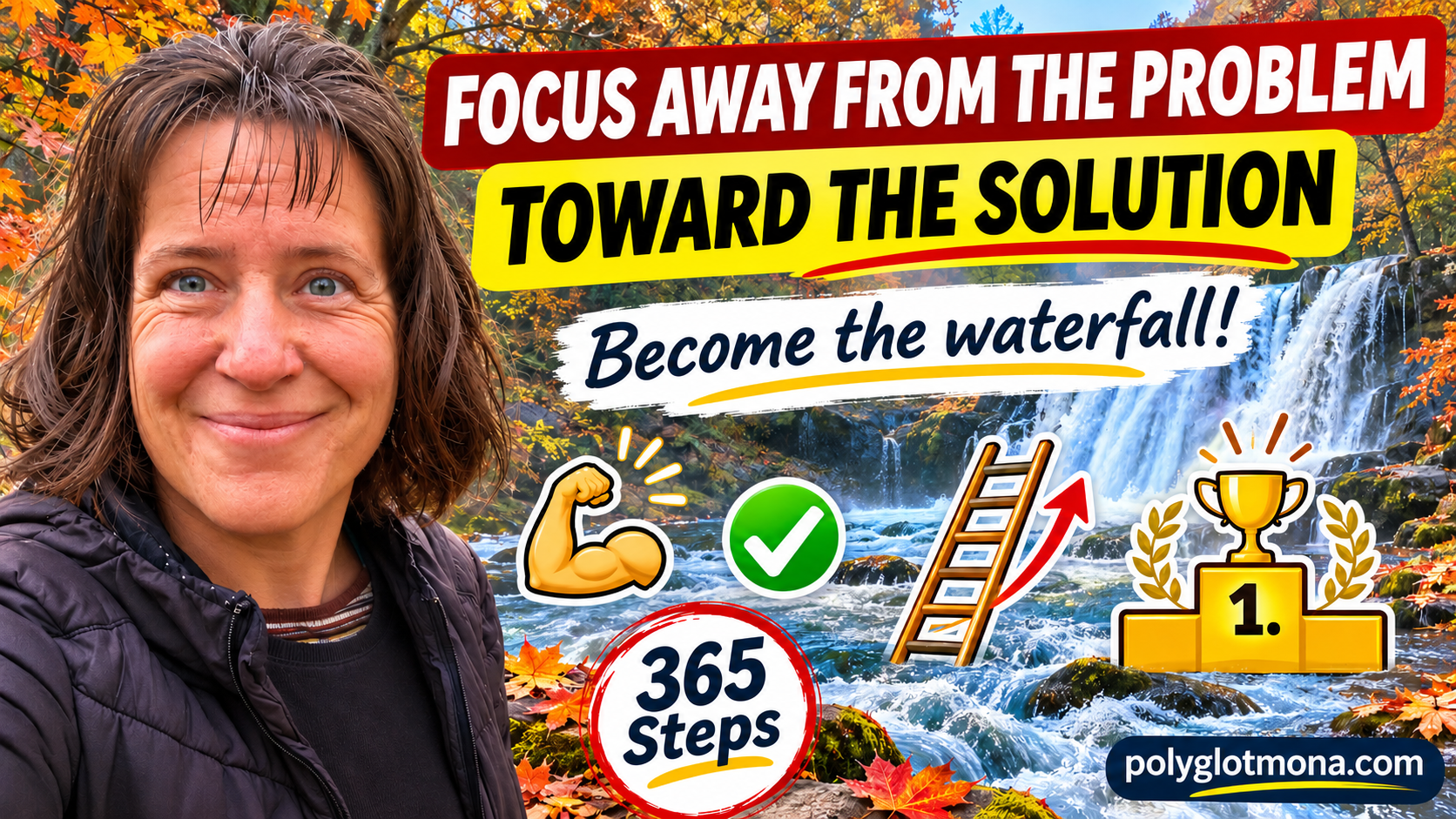
Become the waterfall! A powerful visualisation for greater motivation, ease and confidence in everyday life.
A Waterfall Gives Me an Idea
Sometimes the best ideas come to us quite spontaneously, right in the middle of nature.
I am standing in front of a beautiful waterfall, listening to the tremendous roar of the water.
Huge volumes of water plunge down with incredible force, overcoming rocks and obstacles as they continue their journey relentlessly.
As I enjoy this magnificent sight, an idea comes to me.
What if we thought of the waterfall as a symbol of our problems and their solutions?
The perspective we choose makes an enormous difference.
If we see the waterfall as a problem, it might seem threatening, overwhelming and impossible to conquer.
We hear the noise, feel the tremendous force of the water and imagine how difficult it would be to fight against it.
But what happens when we change our perspective?
What if the waterfall were not the problem but the solution?
Suddenly, that same tremendous power is on our side.
Your Attention Determines What Grows Bigger in Your Mind
When we constantly think about our problems, we repeatedly focus on difficulties, obstacles and possible failures.
Our thoughts revolve around everything that is not working.
We imagine how exhausting the journey will be, how often we might fail and how far away we still are from our goal.
This can discourage us before we have even started.
Of course, problems do not disappear simply because we ignore them.
It is important to recognise difficulties, understand their causes and realistically assess what we can change.
But once we understand the problem, we can consciously direct our attention towards possible solutions.
Our thoughts influence how we perceive a situation, which emotions arise and which actions we eventually choose.
The crucial change in perspective is therefore this:
The focus should not be on the problem but on the next step towards a solution.
Example: Losing Weight – From a Burdensome Problem to a Positive Lifestyle
Let us imagine that someone wants to lose weight.
If this person focuses exclusively on the problem, thoughts like these might arise:
“I weigh far too much.”
“I absolutely have to lose weight.”
“This is going to be incredibly exhausting.”
“I won’t be allowed to eat my favourite foods any more.”
“I’ve tried to change things so many times before.”
Thoughts like these can create pressure and associate everyday life with restriction, guilt and frustration.
But we can look at the same situation differently.
Instead of constantly thinking about our weight, we can focus on habits that are good for us.
“I move my body every day and enjoy the fresh air.”
“I eat a balanced diet and discover foods that taste good and nourish my body.”
“I am learning to pay attention to hunger, fullness and my body’s needs.”
“I am developing a healthier lifestyle step by step.”
“I appreciate my progress, even when it is small.”
This shifts our focus away from an unwanted situation and towards concrete actions that we can choose for ourselves.
Of course, positive thinking alone cannot create good health, and changes in body weight depend on numerous physical and personal factors.
However, a solution-focused mindset can help us develop beneficial habits and maintain them over the long term.
The goal is not to constantly fight against our own bodies but to work lovingly with them.
Imagine That You Are the Waterfall
Now we come to the heart of my idea.
Do not simply imagine the waterfall as a beautiful natural scene.
Imagine that you are the waterfall yourself.
You are not the rock against which the water crashes.
You are the water that finds its way.
You feel the power of the enormous volumes of water.
You hear the roar that drowns out every other sound.
You watch the water flow over the edge of the cliff and seemingly effortlessly overcome the difference in height.
You feel the movement, vitality and energy.
The water does not stop to think about how difficult its journey might be.
It simply keeps flowing.
Sometimes it encounters obstacles, sometimes it divides into several streams, and sometimes it gathers in a calm pool before continuing.
But its movement continues.
You can apply this image to your own goals.
Perhaps you want to live more healthily, learn a language, complete a difficult project or change a habit that is holding you back.
Instead of repeatedly imagining how enormous the obstacle is, imagine the strength with which you will take your next steps.
You do not have to achieve everything at once.
Even a mighty waterfall consists of countless individual drops of water.
And you, too, achieve great goals through many small decisions.
The Power of Visualisation
Visualisation means imagining a particular situation as vividly as possible in your mind.
We can consciously combine images, sounds, movements and feelings.
This technique is used in sport and mental training, among other areas.
It can help us focus our attention, mentally prepare for actions and strengthen our confidence.
However, it is particularly useful not to visualise only the desired result.
We should also imagine how we will actually take the necessary steps and deal with difficulties.
That is why my waterfall method combines this powerful image from nature with a concrete action.
The waterfall does not merely remind you of what you want to achieve.
Above all, it reminds you of what you can do about it today.
The Waterfall Method: A Simple Exercise for Every Morning
Find a quiet moment in the morning before turning your attention to the day’s tasks.
You can sit comfortably, close your eyes and take a few calm breaths.
Then imagine a magnificent waterfall plunging over a high rock face.
In your imagination, listen to the steady, powerful roar.
See the sparkling droplets of water, the movement and the light reflecting on the surface.
Now imagine that this natural power represents your own determination.
You are full of energy without being tense.
You are determined without being impatient.
You are powerful and flexible at the same time.
Now think of a specific goal that matters to you.
Ask yourself what small step you can take today to move closer to that goal.
Perhaps you want to go for a walk, prepare a healthy meal, study for twenty minutes or start an uncomfortable conversation in a friendly and constructive way.
Imagine as precisely as possible how you will carry out this action.
Where are you?
What do you do first?
How will you respond if you do not feel like doing it or something unexpected happens?
To finish, you can say a simple sentence to yourself:
“I will find my way and take the next step today.”
Open your eyes and begin your day with this image in your mind.
When Temptation Strikes: Remember the Waterfall
This method can be especially helpful in moments when we feel tempted to abandon our good intentions.
Perhaps you suddenly crave something sweet even though you are not actually hungry.
Perhaps you feel like skipping your planned walk.
Or perhaps you do not feel like continuing an important project.
In situations like these, you do not need to criticise yourself or put yourself under pressure.
Simply pause for a moment and remember your waterfall.
Imagine the movement of the water and ask yourself which decision would take you in the direction you want to go.
Perhaps you decide to take a short walk.
Perhaps you realise that you really are hungry and would like something to eat.
Perhaps you start by working on your project for just five minutes.
The point is not to suppress every spontaneous desire or never deviate from a plan.
The point is to make more conscious decisions instead of automatically reacting to every passing mood.
You do not have to be perfect to keep moving forward.
The Effortless Flow of Water
There is another quality of the waterfall that I find particularly fascinating.
Although the water has enormous power, its movement also seems natural and effortless.
It does not have to force itself to flow.
It simply follows its course.
Of course, we human beings cannot always overcome our challenges so effortlessly.
Some changes require patience, discipline, support and many fresh attempts.
But we can learn to spend less energy fighting ourselves and more energy taking helpful action.
Instead of constantly thinking that we absolutely must achieve something, we can ask ourselves how to make the next step easier and more enjoyable.
Perhaps we combine physical activity with a lovely trip into nature.
Perhaps we learn a foreign language through an exciting story.
Perhaps we divide an unpleasant task into small, manageable parts.
Ease does not mean that we no longer need to make an effort.
It means looking for ways to make it easier to keep going.
What If an Obstacle Seems Too Big?
Even the most powerful waterfall cannot simply break through every obstacle.
The water changes direction, divides into different streams or gathers before flowing onwards.
This is a valuable image for our own goals.
Sometimes putting in even more effort does not help.
Sometimes we need to find another way.
Perhaps our goal is too big to achieve in a single step.
Perhaps we lack information, suitable tools or support from other people.
Perhaps we need to change our original plan.
Solution-focused thinking does not mean stubbornly clinging to one particular idea.
It means remaining open to different possibilities.
If one approach does not work, we can try another.
And sometimes taking a break is also a meaningful part of the solution.
Five Questions to Help You Change Your Perspective
When you are struggling with a problem, you can ask yourself these questions:
What exactly is my problem, and what aspects of it can I actually influence?
What would a good, realistic solution look like?
What options are available to me?
What is the smallest meaningful step I can take today?
How will I recognise that I am making progress, even if I have not yet reached my goal?
These questions help you consciously shift your attention from worrying to taking action.
You do not have to find a perfect answer to every question immediately.
Sometimes just one small idea is enough to get moving again.
A Waterfall as Your Daily Companion
I think it is wonderful when we can use images from nature to remind ourselves of important ideas.
Perhaps you have stood in front of a waterfall yourself and felt its tremendous power.
Or perhaps you can simply imagine such a place in your mind.
You could use a photograph of a waterfall as the background on your phone.
Or you could spend a few minutes in the morning listening to the sound of rushing water while focusing your thoughts on the day ahead.
Whenever you see this image or hear the sound, you can remind yourself of your intention.
“I focus not only on the obstacle but, above all, on finding my way through it or around it.”
In this way, a beautiful experience in nature becomes a personal reminder that you can carry into your everyday life.
My Conclusion: Become the Waterfall!
We all face challenges in life that sometimes seem enormous.
When we focus all our attention on these difficulties, we can quickly begin to feel overwhelmed.
But as soon as we start looking for solutions, new possibilities for action open up.
The waterfall reminds me how powerful movement can be.
It also shows me that strength and ease do not have to be opposites.
We can be determined without constantly putting ourselves under pressure.
We can change direction without losing sight of our goal.
And we can appreciate every little bit of progress.
That is why I would like to leave you with this image today:
Become the waterfall!
Imagine its strength, feel its movement and carry its effortless flow into your everyday life.
Focus not only on what is holding you back but, above all, on what will help you move forward.
And then begin with one small step.
Because change does not come from our thoughts alone but, above all, from what we do with them.
What Do You Think of the Waterfall Method?
Can you imagine using a waterfall as a symbol of your own strength and determination?
Which problem would you like to approach more from the perspective of possible solutions in the future?
I look forward to hearing your thoughts and experiences!
I wish you a wonderful day and lots of joy as you discover your own path.
365 Steps to Learning – Your Online Magazine for Personal Development
“365 Steps to Learning” is one of PolyglotMona’s twelve Mediabook series, designed to help you grow and develop personally, step by step.
A new issue of the online magazine is published on the 15th of every month in six languages: German, English, French, Spanish, Italian and Russian.
In this month’s issue, you will find 24 questions and answers with practical tips on solution-focused thinking.
You will discover how to consciously shift your attention from problems to solutions, develop new perspectives and achieve your goals through small, concrete steps.
Let yourself be inspired and discover how to approach everyday life with greater confidence, creativity and ease.
Available now in the shop under “365 Steps”:


Leave a Reply