


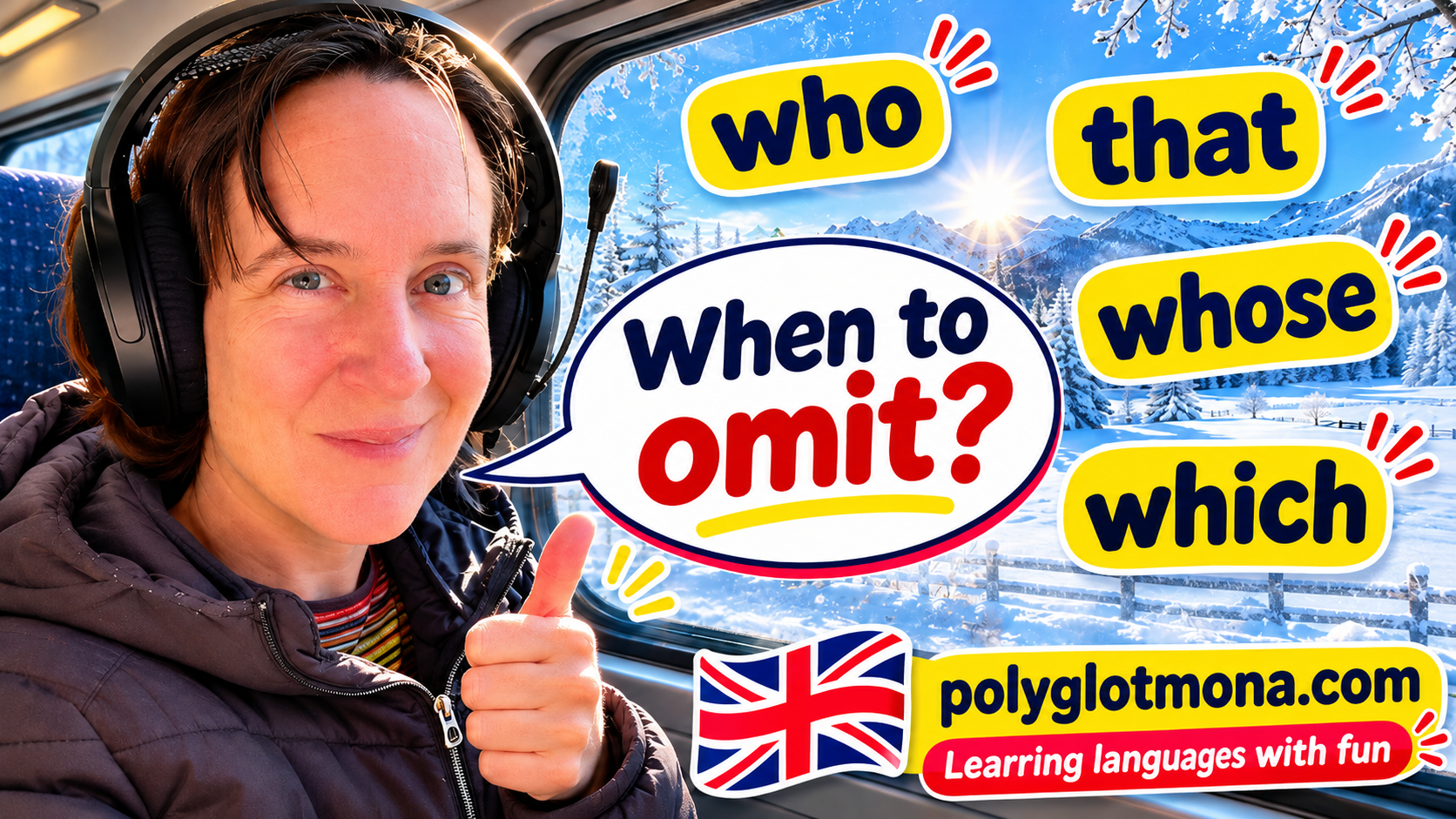
Relative clauses allow you to describe people, animals and objects in more detail and connect information.
In this article, you will learn which relative pronouns to use in English and when you can omit them.
First, open this article in your native language in the PolyglotMona app and try to translate the example sentences into English on your own.
Then select English as your second language and check your translations.
What Is a Relative Clause?
A relative clause is a subordinate clause that describes a person, an animal, an object or a situation in more detail.
The relative pronoun refers to a word or group of words in the main or higher-level clause.
This word or group of words is called the antecedent.
English Relative Pronouns – Who, Which, That and Whose
Who – Relative Pronoun for People
You normally use this relative pronoun when you want to describe a person in more detail.
01 – The girl who lives next door is my friend.
02 – The man who is standing over there is my father.
03 – The teacher who teaches us English is very friendly.
04 – The boy who I met yesterday is called Paul.
05 – The woman who we saw in the park is our neighbour.
Which – Relative Pronoun for Animals and Things
You normally use this relative pronoun for animals, objects and other non-human antecedents.
06 – The book which is lying on the table belongs to me.
07 – The bicycle which is standing in front of the house is new.
08 – The dog which is playing in the garden is very young.
09 – The film which we watched yesterday was exciting.
10 – The dress which she bought is beautiful.
That – Relative Pronoun for People, Animals and Things
In defining relative clauses, you can use this relative pronoun for people, animals and things.
It can replace the two relative pronouns introduced above.
11 – The boy that plays football is my brother.
12 – The cat that is sleeping on the sofa belongs to my sister.
13 – The car that is parked in front of the school is blue.
14 – The cake that my mother baked tastes delicious.
15 – The shoes that I bought yesterday are comfortable.
Whose – Possession and Association
This relative pronoun expresses possession or a relationship between someone or something and another person or thing.
It can refer to people, animals and things.
16 – The boy whose father is a doctor is in my class.
17 – The girl whose bicycle is broken is taking the bus today.
18 – The woman whose daughter lives in London is our neighbour.
19 – The man whose dog has run away is looking for it everywhere.
20 – The house whose roof is damaged needs to be renovated.
When Can You Omit a Relative Pronoun? – Contact Clauses
In English, you can omit certain relative pronouns under specific circumstances.
A relative clause without a relative pronoun is called a contact clause.
Whether you can omit a relative pronoun depends on its grammatical function and the type of relative clause.
The Relative Pronoun Is the Subject – Subject Relative Pronouns
If the relative pronoun itself is the subject of the relative clause, you must not omit it.
The subject tells us who or what performs an action or is in a particular state.
21 – The man who works there is my uncle.
22 – The girl who is singing has a beautiful voice.
23 – The dog that is barking loudly belongs to our neighbours.
24 – The car which is parked in front of our house belongs to my father.
25 – The children who are playing in the garden are happy.
In all these sentences, the relative pronoun functions as the subject of the relative clause and must therefore be included.
The Relative Pronoun Is the Object – Object Relative Pronouns
If the relative pronoun is the object of a defining relative clause, you can omit it.
In this case, the relative clause already has its own subject.
26 – The book I am reading at the moment is interesting.
27 – The boy you met yesterday is my cousin.
28 – I like the music we are listening to.
29 – The computer he bought was expensive.
30 – The story she told was funny.
In these sentences, you can either include the relative pronoun or omit it, as in the examples above.
How to Identify the Subject or Object
One simple method is to look at the words that follow the relative pronoun in the English sentence.
If a verb immediately follows the relative pronoun, the relative pronoun is usually the subject.
If the relative pronoun is followed by a separate subject and then a verb, the relative pronoun is often the object.
This rule of thumb works for many simple relative clauses, but you should still check the grammatical function of the relative pronoun.
31 – The man who visited me is my uncle.
32 – The man I visited is my uncle.
33 – The girl who called me is my friend.
34 – The girl I called is my friend.
35 – The dog that saw me is very friendly.
36 – The dog I saw is very friendly.
37 – The woman who invited us lives in London.
38 – The woman we invited lives in London.
39 – The boy who helped me is very nice.
40 – The boy I helped is very nice.
In the odd-numbered examples in this section, the relative pronoun is the subject, while in the even-numbered examples, the relative pronoun would be the object and has therefore been omitted.
Which Relative Pronoun Can Never Simply Be Omitted? – Whose
You cannot simply omit the relative pronoun that expresses possession or association.
It modifies the noun that follows it and is therefore essential to the meaning of the sentence.
41 – The girl whose mother is a teacher loves learning.
42 – The boy whose sister lives in England speaks English well.
43 – The woman whose car was stolen called the police.
44 – The pupil whose homework is missing must bring it in tomorrow.
45 – The family whose house was sold is moving to Berlin.
Defining Relative Clauses
A defining relative clause contains information that we need to identify the person or thing being described.
In English, defining relative clauses are not separated from the rest of the sentence by commas.
In this type of relative clause, a relative pronoun can be omitted if it functions as an object and does not express possession.
46 – The pupils who study hard pass the exam.
47 – I like the book you gave me.
48 – The man who helped us is a police officer.
49 – The hotel we booked is by the sea.
50 – The bag I am looking for is black.
Non-defining Relative Clauses
A non-defining relative clause provides additional information about a person or thing that has already been clearly identified.
This additional information could be removed without making it unclear which person or thing is being referred to.
In English, these relative clauses are separated from the rest of the sentence by commas.
In non-defining relative clauses, you must not omit the relative pronoun, even if it is an object.
That – Not in Relative Clauses with Commas
The relative pronoun that, which can refer to people, animals and things, must not be used in non-defining relative clauses.
51 – My mother, who lives in Munich, is visiting me tomorrow.
52 – London, which I visited last year, is a fascinating city.
53 – My brother Paul, who works in England, is coming home next week.
54 – My new bicycle, which I bought yesterday, is very comfortable.
55 – My friend Anna, whose mother is a doctor, wants to study medicine.
Relative Clauses with Prepositions
In relative clauses with prepositions, you can also omit the relative pronoun under certain circumstances.
If the relative pronoun is the object of a preposition in a defining relative clause, the preposition can be placed at the end of the relative clause.
In this case, the relative pronoun can be omitted.
However, if the preposition is placed immediately before the relative pronoun, you must not omit the relative pronoun.
56 – The man I spoke to is very friendly.
57 – The topic we talked about was interesting.
58 – The person I am waiting for will be here soon.
59 – The chair I am sitting on is uncomfortable.
60 – The company she works for is internationally renowned.
Summary – The Most Important Rules for Your English Test
Who
You use this relative pronoun for people.
You can omit it if it is the object of a defining relative clause.
Which
You normally use this relative pronoun for animals and things.
You can omit it if it is the object of a defining relative clause.
That
You can use this relative pronoun for people, animals and things in defining relative clauses.
You can omit it if it is the object of the relative clause.
Whose
This relative pronoun expresses possession or association and cannot simply be omitted.
Contact Clauses
A defining relative clause in which a relative pronoun functioning as an object has been omitted is called a contact clause.
Unlike in English, you cannot omit the relative pronoun in such clauses in German.
Exercises on English Relative Clauses
Exercise 1 – Choosing the Correct Relative Pronoun
Translate the corresponding sentences from your native language into English and use a suitable relative pronoun in each sentence.
61 – The girl who plays tennis is my sister.
62 – The book which is lying on my desk belongs to my brother.
63 – The man whose daughter is in my class works at the hospital.
64 – The cat that is sitting in the tree is frightened.
65 – The teacher who teaches us maths is very patient.
66 – The mobile phone that I lost was new.
67 – The woman whose dog is ill is going to the vet.
68 – The film which we watched was boring.
69 – The boy who wrote to me lives in England.
70 – The girl whose parents come from Spain speaks three languages.
Exercise 2 – Subject or Object?
Translate the corresponding sentences from your native language into English and decide whether the relative pronoun is the subject or the object of the relative clause.
Then decide whether you can omit the relative pronoun.
71 – The dog that is following me is very big.
72 – The dog that I feed is very big.
73 – The girl who visits me is my cousin.
74 – The girl who I visit is my cousin.
75 – The man who is repairing the car is a mechanic.
76 – The car which the man is repairing belongs to my mother.
77 – The woman who knows us is very nice.
78 – The woman who we know is very nice.
79 – The pupil who is answering the question is very attentive.
80 – The question which the pupil is answering is difficult.
Exercise 3 – Forming Contact Clauses
Translate the corresponding sentences from your native language into English and omit the relative pronoun wherever this is grammatically possible.
81 – I like the present you gave me.
82 – The woman who is waiting over there is my aunt.
83 – The film I watched yesterday was funny.
84 – The child whose mother is working is staying with their grandmother.
85 – I like the song we listened to yesterday.
86 – The bus that is arriving now goes to the city centre.
87 – The jacket you are wearing is very nice.
88 – The man who sold us the tickets was friendly.
89 – The person I spoke to was helpful.
90 – The restaurant we visited yesterday was excellent.
Exercise 4 – Defining and Non-defining Relative Clauses
Translate the corresponding sentences from your native language into English and decide whether each relative clause is defining or non-defining.
Pay particular attention to English punctuation and whether the relative pronoun can be omitted.
91 – The pupils who have forgotten their homework must stay longer.
92 – My sister Anna, who lives in London, is visiting me in the summer.
93 – The book that I bought yesterday is exciting.
94 – Paris, which I visited last summer, is beautiful.
95 – The man whose car is parked in front of the school is our new teacher.
96 – My best friend Lisa, whose father is a musician, plays the piano.
97 – The bag which I saw in the shop was too expensive.
98 – My new computer, which I bought yesterday, works perfectly.
99 – The people who helped us live on our street.
100 – My grandfather Karl, who I visit every Sunday, loves telling stories.
Revision and Comprehension Questions
01 – What is a relative clause?
02 – Which relative pronoun is normally used for people?
03 – Which relative pronoun is normally used for animals and things?
04 – Which relative pronoun can be used for people, animals and things in defining relative clauses?
05 – Which relative pronoun expresses possession or association?
06 – Can you omit a relative pronoun if it is the subject of the relative clause?
07 – Under what circumstances can you omit a relative pronoun that functions as an object?
08 – What is a contact clause?
09 – What is the difference between a defining and a non-defining relative clause?
10 – Can you omit the relative pronoun in a non-defining relative clause?
Answer Key
You can find the answers to the exercises and comprehension questions in a separate article.
My students receive the answer key free of charge.
If you are not taking lessons with me, you can purchase the answer key for €0.50 via PayPal.
Please send me a message before making your payment.
Enjoy learning English and good luck!


Leave a Reply